

With the southwest monsoon expected to enter Rajasthan next week—around a week later than usual—concerns over weak rainfall are growing. But a 30-year analysis shows that a late arrival has often ended with an above-normal season.
A delayed monsoon has once again become the centre of Rajasthan’s weather conversation.
Last year, the southwest monsoon reached the state seven days ahead of schedule and went on to deliver record-breaking rainfall. This year, forecasts suggest it could arrive almost a week late, raising concerns over whether the delay will translate into a weaker rainy season.
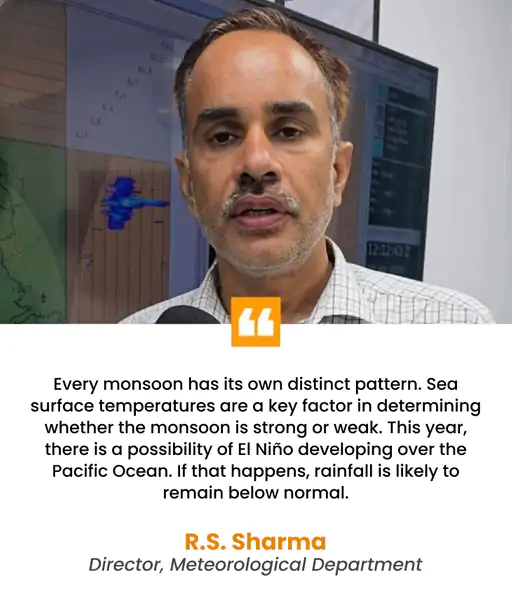
The India Meteorological Department (IMD) expects the monsoon to enter Rajasthan next week. Seasonal forecasts also indicate rainfall could remain up to 10 per cent below normal.
However, a 30-year analysis by Bhaskar, covering the period from 1996 to 2025, suggests the timing of the monsoon’s arrival has rarely determined how much it rains.
The data shows the monsoon reached Rajasthan on time only twice in three decades. It arrived 15 times ahead of schedule and 13 times after the normal date. More importantly, several delayed monsoons went on to produce surplus rainfall, while some early arrivals ended with rainfall deficits.
The numbers suggest that the arrival date alone is a poor predictor of the season’s performance.
The biggest delays still ended with healthy rainfall
Over the past three decades, the IMD’s expected date for the monsoon’s arrival in Rajasthan has generally fallen between June 20 and June 25, while normal seasonal rainfall has ranged between 415 mm and 435.6 mm, depending on the climatological period.
Using June 25 as the benchmark for analysis, Bhaskar examined how rainfall behaved when the monsoon arrived early or late.
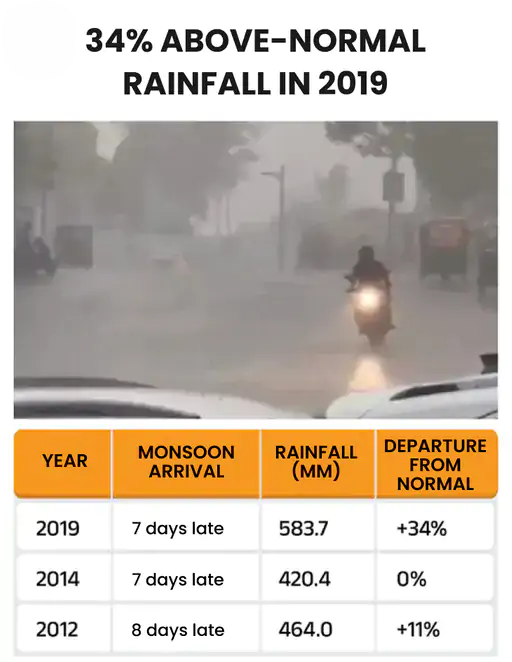
The most delayed arrival came in 2012, when the monsoon entered Rajasthan eight days late. Initial concerns faded after heavy August rainfall pushed the seasonal total to 11 per cent above normal.
A similar pattern emerged in 2019, when the monsoon was delayed by seven days. Instead of a weak season, Rajasthan recorded more than 550 mm of rainfall—the highest in three decades at the time. On the very first day, the monsoon spread across more than half the state.
In 2014, another seven-day delay resulted in rainfall that remained close to normal.
The data shows that every monsoon arriving as late as July has avoided ending the season with a rainfall deficit over the past 30 years.
Delays of up to five days produced mixed outcomes
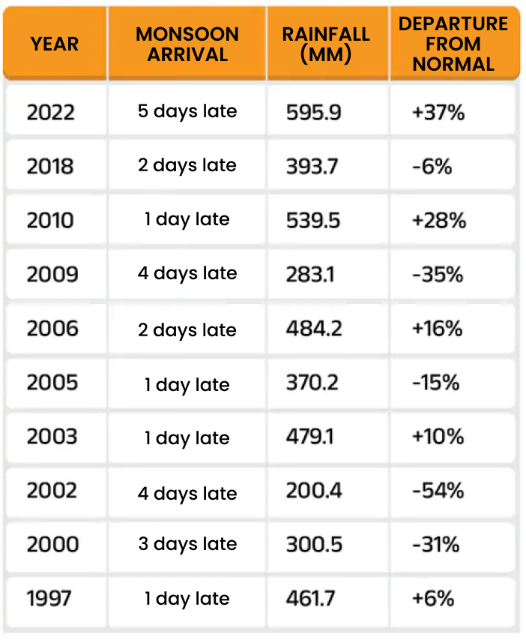
The monsoon arrived up to five days late on ten occasions during the study period.
Five of those years recorded above-normal rainfall, while the remaining five ended below normal, indicating that a short delay alone offers little clue about the season ahead.
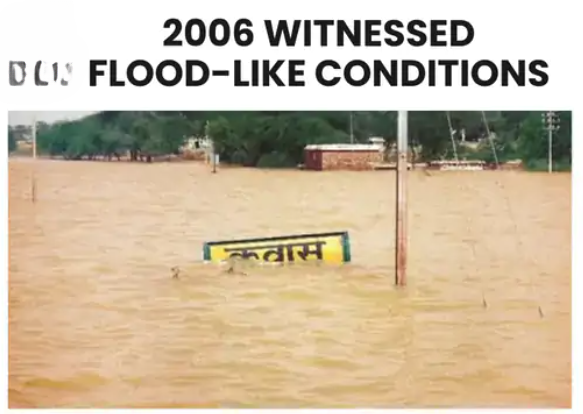
One of the most dramatic examples came in 2006, when the monsoon entered Rajasthan just two days late. In the last week of August, Barmer received nearly five times its annual average rainfall, triggering widespread flooding.
Not every delayed monsoon was generous. In 2002 and 2009, both marked by a four-day delay, Rajasthan experienced drought conditions.
Then came 2022, when the monsoon was five days late but still delivered 596 mm of rainfall across the state. Eastern Rajasthan alone received nearly 781 mm.
In 2010, despite arriving one day late, the monsoon produced nearly 540 mm of rainfall, with both eastern and western Rajasthan recording around 27 per cent more rain than normal.
On-time arrivals were rare—and both were wet
In three decades, the monsoon reached Rajasthan exactly on schedule only twice.
Both years produced above-normal rainfall.
In 2024, Rajasthan received around 679 mm of rainfall, while 2023 ended with rainfall roughly 15 per cent above normal.
Although on-time arrivals have been uncommon, they have consistently coincided with healthy monsoon seasons.
Early arrivals usually helped—but not always
The earliest monsoon arrivals occurred four times during the 30-year period, and each delivered above-average rainfall.
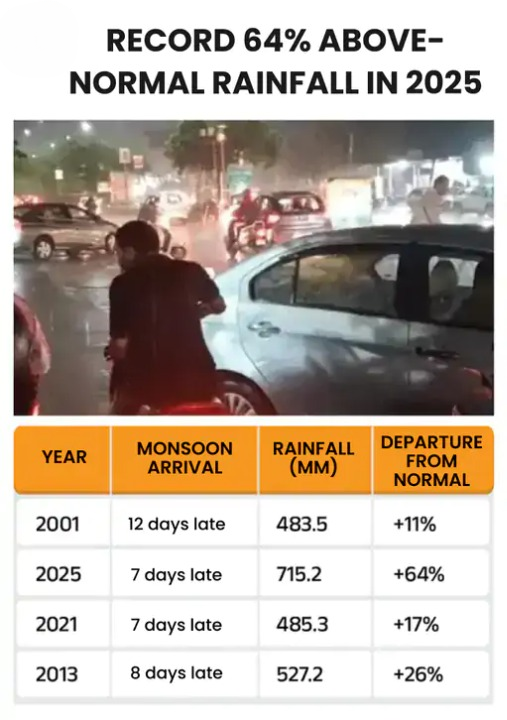
In 2001, the monsoon entered Rajasthan 12 days early, producing rainfall around 11 per cent above normal.
The biggest headline, however, came in 2025, when the monsoon arrived seven days ahead of schedule and delivered 64 per cent more rainfall than normal, breaking a 108-year rainfall record.
Another early arrival in 2021, also seven days ahead of schedule, ended with rainfall 17 per cent above normal.
An early monsoon did not always prevent drought
While very early arrivals generally favoured a good season, monsoons arriving one to four days ahead of schedule produced mixed results.
This happened 11 times over the last three decades.
In 1999, the monsoon arrived one day early, yet rainfall finished 25 per cent below normal.
In 2004, it entered three days early, but seasonal rainfall was 22 per cent below normal, leaving Rajasthan with drought-like conditions.
In 2011, despite a one-day early arrival, rainfall remained 11 per cent below normal, although the overall situation stayed manageable.
On the other hand, 1996, 2011, and 2016 all saw the monsoon arriving two to three days early, with seasonal rainfall crossing 500 mm. The strongest performance came in 2011, when rainfall exceeded 590 mm, about 41 per cent above normal.
The takeaway: Arrival date is only the beginning
The 30-year record challenges the common belief that a delayed monsoon inevitably means poor rainfall.
Rajasthan has witnessed several late monsoons that ended with abundant rainfall, just as it has seen early arrivals fail to deliver.
For farmers, planners and residents anxiously waiting for the first monsoon clouds, history offers a reassuring message: the date of arrival may shape expectations, but it does not determine the outcome. What matters far more is how the monsoon performs through July, August and September.