

Bangladesh has now turned towards China for its Teesta River project near Siliguri corridor, a sensitive border area.
The move gains significance as it comes shortly after Bangladesh congratulated the BJP on its West Bengal win and raised the Teesta issue with India last week.
Moreover, Dhaka reiterated its firm adherence to the One-China policy, and reaffirmed that Taiwan is an inalienable part of China.
In today’s Explained we take a look at the latest move in India’s neighbourhood and what it means for New Delhi.
What is the Teesta River Project?
The Teesta River is a 414 km long glacier-fed river originating in the eastern Himalayas, located on the border of Sikkim, India, Tibet, China.
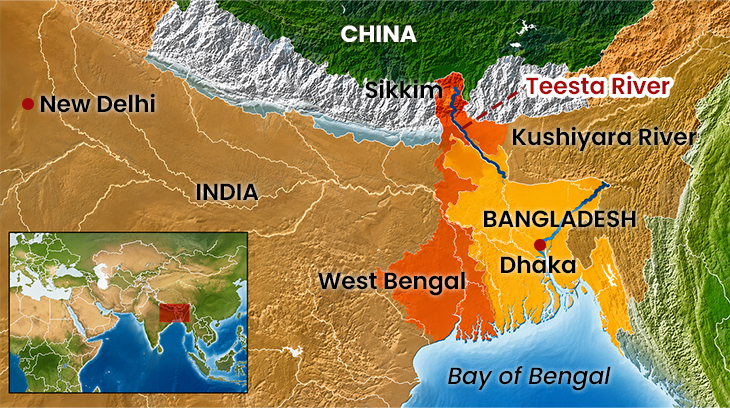
It flows through Sikkim, West Bengal and Bangladesh to merge with the Bhramaputra which is known as Jamuna river in Bangladesh.
It is known as the lifeline of Sikkim, northern West Bengal and Bangladesh providing vital irrigation, hydropower and supports livelihoods of lakhs.
The Project
India already has several major projects on the Teesta River in Sikkim and West Bengal.
- These include dams and hydropower plants, along with the Teesta Barrage Project that supports irrigation.
- While India’s projects mainly focus on electricity generation and farming needs.
- Bangladesh’s proposed Teesta River Comprehensive Management and Restoration Project (TRCMRP).
- The project, backed by China, aims to reduce water shortages during summer and control floods during monsoon by deepening the river on the Bangladesh side, building embankments for storing water and developing nearby land for farming and industries.
Both projects aim to manage the river’s water flow, though they are major points of tension between the nations due to competing needs for water during the dry season
So what is the Teesta River dispute between India and Bangladesh?
The Teesta river water-sharing deal between India and Bangladesh has remained unresolved for more than a decade and a half.
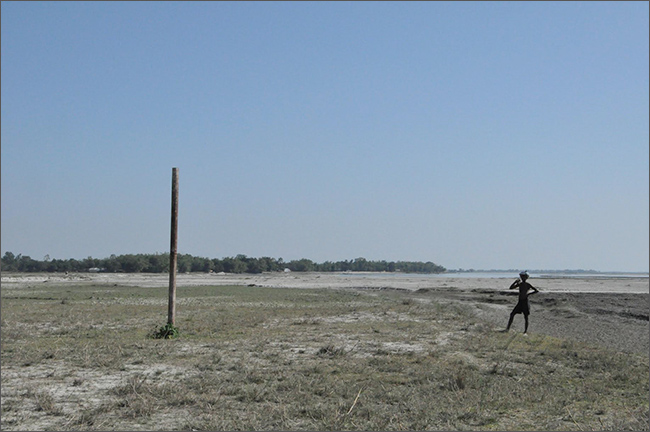
Iron boundary pillars marking the India-Bangladesh border at Mekhligunj in West Bengal are frequently submerged during the monsoon season. (Photo ORF, 2016 )
The Teesta dispute is mainly about sharing the river’s water during the dry season, when water flow drops sharply between December and March to May.
- Bangladesh says reduced upstream withdrawal by India affects irrigation, farming and livelihoods in its northern districts, while West Bengal argues it also faces water shortages.
India and Bangladesh reached a temporary arrangement in 1983 under which India would receive 39 per cent of Teesta waters and Bangladesh 36 per cent, while the remaining 25 per cent was left unallocated.
- In 2011, during former Prime Minister Manmohan Singh’s Bangladesh visit, a proposed agreement suggested 37.5 per cent of Teesta waters for Bangladesh and 42.5 per cent for India.
- The 2011 draft agreement failed to materialise after then West Bengal chief minister Mamata Banerjee opposed it, citing it would hurt farmers and irrigation in north Bengal.
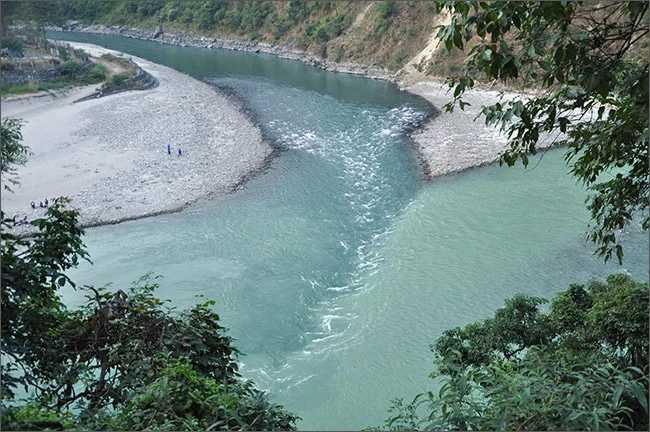
The confluence of the Rangeet and Teesta rivers at Teesta Bazaar in Darjeeling, with the Teesta flowing on the right. (Photo: ORF)
Since water-related matters also involve state governments in India, the central government in New Delhi could not finalise the agreement without West Bengal’s consent.
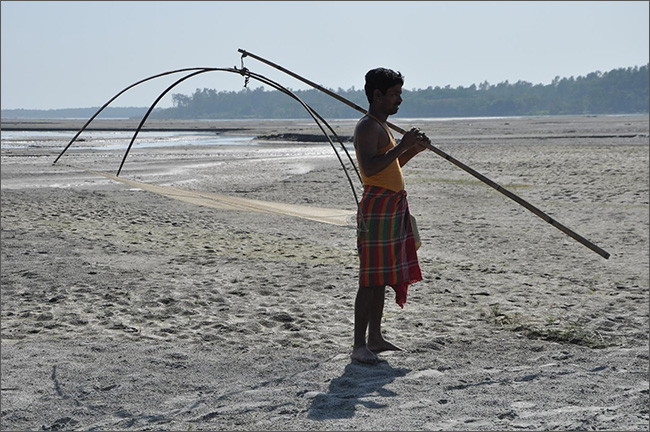
A fisherman in Mekhligunj, West Bengal, stands on the dry bed of the Teesta River holding a net designed for use in shallow waters. (Photo: ORF, 2016)
Despite ideological differences between Bangladesh’s ruling BNP and India’s BJP, BNP leaders say both sides remain aligned on issues linked to national interest and bilateral ties.
BNP Information Secretary Azizul Baree Helal told ANI: ‘

We have a good relationship. Ideologically, we are different, but on some issues, we are very much united, like the Teesta Barrage and the general relationship between Bangladesh and India. On an issue basis, we are united, even if ideologically separated. I think with the new BJP government in West Bengal, our relationship will be accelerated more and more.
Why is Bangladesh seeking China’s support for the Teesta project now?
First, it is important to note that in 2024, shortly after returning from her visit to China, former Bangladesh PM Sheikh Hasina said that China had made proposals and conducted a feasibility study on the Teesta project, while India had also offered support and would carry out a feasibility assessment.
Hasina said in 2024 after her China visit that:
But I would prioritise that India will do it. India holds the water of Teesta River…. So, they should do the project and they would give whatever is necessary here if they do the project.
However, subsequent political turmoil in Bangladesh and her ouster from office led to the Teesta-related discussions slowing down and effectively remaining in abeyance.
- Cut to 2026 where Bangladesh’s latest move to seek China’s support for the Teesta project comes after a major political shift in Dhaka following the rise of Prime Minister Tarique Rahman and the BNP government in February 2026.
Rahman came to power after elections seen as a major break from the era of former Prime Minister Sheikh Hasina, who was ousted in August 2024 following massive student-led protests over corruption allegations, authoritarian rule and a controversial quota system.
A violent crackdown that killed 1,400 people eventually forced Hasina to resign and flee to India in 2024.
- Soon after taking office, Rahman signalled a more interest-driven foreign policy, saying on 14 February victory speech 2026: ‘The interests of Bangladesh and its people will determine our foreign policy.’
- Earlier, in a BBC Bangla interview published on 7 October 2025, Rahman had said: ‘Bangladesh comes first. I will prioritise the interests of my country’s people and my nation’s interests first.’
- Against this backdrop, Bangladesh formally discussed the Teesta River Comprehensive Management and Restoration Project (TRCMRP) with China during a 6 May meeting in Beijing between Foreign Minister Khalilur Rahman and Chinese Foreign Minister Wang Yi.
- Dr. Rahman visited China from 5 May to 7 at the invitation of Wang Yi, marking his first official visit to China since assuming office, reported state-owned news agency Bangladesh Sangbad Sangstha (BSS).
‘Congratulates BJP’
The meeting came just two days after the BJP’s victory in the West Bengal Assembly elections, which the BNP’s Information Secretary Azizul Baree Helal on 5 May publicly welcomed while talking to news agency ANI.
‘I congratulate BJP’s win,’ the Bangladesh leader said.
Why now?
- Talking to news the news agency Helal also claimed that the previous government led by Mamata Banerjee in West Bengal had blocked progress on the Teesta water-sharing agreement.
They now hope the new BJP government under Suvendu Adhikari will work more closely with Prime Minister Narendra Modi to move the agreement forward.
But Why China?
At the same time, Dhaka’s outreach to China signals that Bangladesh is keeping multiple options open and seeking faster progress on the long-pending Teesta project.
Talking to Bhaskar English, China expert Dr. Sriparna Pathak also a professor at O.P. Jindal Global University, Haryana says that Bangladesh’s BNP understands it cannot fully move away from India if it wants economic progress, and is trying to maintain good ties.
- However, she noted India is frequently used in Bangladesh’s domestic political narratives.
- Because of this, a fully pro-India stance could also hurt the government politically at home.
How could Chinese involvement in the Testa project affect India?
Chinese involvement in the Teesta project is strategically sensitive for India because the project area lies close to the Siliguri Corridor, the narrow link connecting mainland India to the Northeast.
- The Teesta restoration plan includes dredging, embankments, reservoirs, irrigation and connectivity infrastructure across northern Bangladesh near the Indian border.
- The China expert, Dr Sriparna Pathak explains that a long-term Chinese role could expand Beijing’s technical and infrastructure presence near the Siliguri Corridor through engineers, survey teams and monitoring systems.
- She warns that China wants to keep the Indian neighborhood in constant turmoil, either through Bangladesh, Nepal or Maldives.
- The project could also give China access to geographic and hydrological data near India’s eastern frontier, raising concerns over surveillance and dual-use infrastructure.
The broader concern for India is that Chinese-backed infrastructure projects near Siliguri Corridor could increase Beijing’s strategic influence in Bangladesh near a highly sensitive Indian chokepoint.
What is the Siliguri Corridor and why is it sensitive for India?
The Siliguri Corridor—also known as the “Chicken’s Neck”—is a narrow stretch of land in West Bengal, measuring just 17–22 km at its narrowest point.
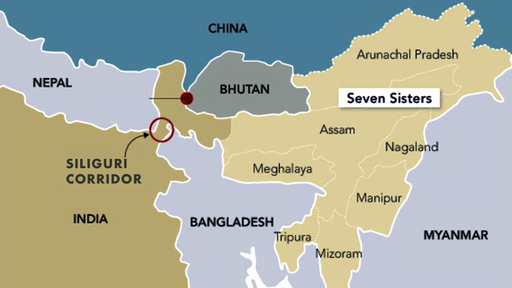
The corridor is surrounded by Bangladesh, Nepal, Bhutan, and, in extension, China, making it strategically sensitive from a security perspective.
- Dr. Prabir De, economist and professor at the Research and Information System for Developing Countries, New Delhi, explains, it is critical because it serves as the only land link connecting mainland India to the eight northeastern states, acting as a vital logistical lifeline for over 4 crore people as well as the military.
Dr. De further notes that the region is also important economically, as tea cultivation is a major source of livelihood for people living there.
What is China’s claim over Taiwan and why does Dhaka back it?
According to Bangladesh Sangbad Sangstha (BSS), during the Bangladesh-China meeting held in China from 5 to 7 May, Dhaka reiterated its firm adherence to the “One China” principle. Bangladesh reaffirmed that Taiwan is an inalienable part of China’s territory and opposed any form of “Taiwan independence”.
China claims Taiwan as an “inalienable” and “inseparable” part of its territory under the “One China” principle, which states that there is only one sovereign state called China and that the People’s Republic of China (PRC) is its sole legitimate government.
- China expert Dr. Sriparna Pathak explains that Bangladesh’s support for China’s claim over Taiwan is largely linked to economics.
- She says many countries in India’s neighbourhood that are economically dependent on China tend to back Beijing’s position on Taiwan.
Taiwan currently maintains formal diplomatic relations with only a small number of countries — 12 as of 2026. In most countries, including India, the US, and the UK, Taiwan operates through “Taipei Economic and Cultural Representative Offices” (TECOs), which function as unofficial diplomatic missions handling trade, cultural, and consular affairs.
- Dr. Pathak explains that the absence of formal Taiwanese embassies in major countries reflects their adherence to the One China policy.
- Official embassies would imply formal recognition of Taiwan as a sovereign and independent state, which most countries avoid while maintaining unofficial ties with Taipei.
China traces its claim over Taiwan to historical records dating back to the 3rd century and argues that the island was part of the Qing dynasty before being ceded to Japan after the First Sino-Japanese War in 1895.
Beijing also maintains that Taiwan was restored to China after World War II under the Cairo Declaration and the Potsdam Proclamation following Japan’s defeat.