
An analysis of 38 parties’ debuts in Assembly polls – 13 in Tamil Nadu and 25 across India – shows that only a handful of them have found success in their bids, and fewer have been able to convert it into a long-term presence
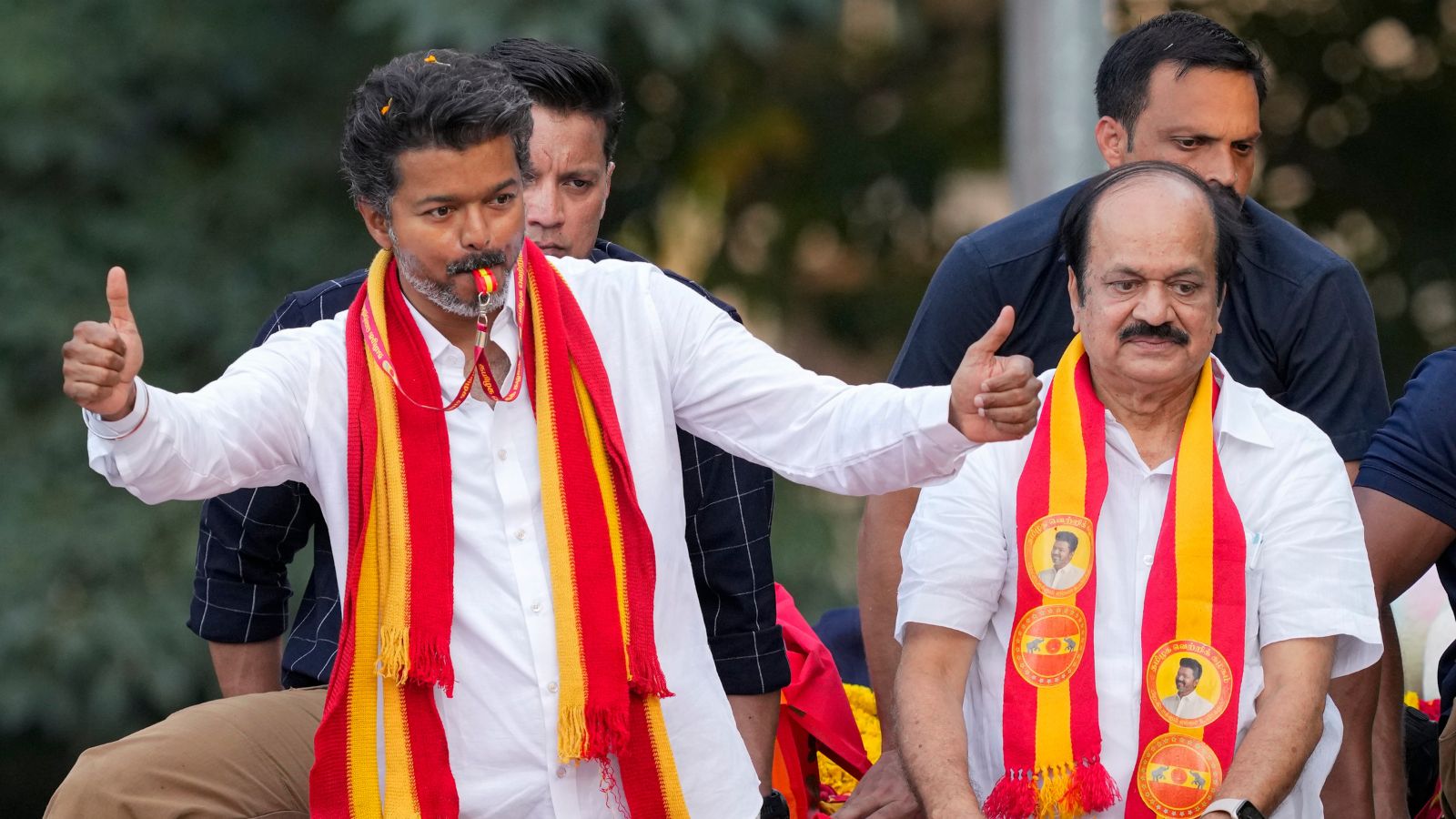
As superstar-turned-politician Vijay’s Tamilaga Vettri Kazhagam (TVK) makes a stunning debut in the Tamil Nadu Assembly elections – surging towards a win with leads in 108 seats, just short of the 118-seat majority in the 234-member House – it has unsettled the state’s political landscape centred on the Dravidian ideology. However, history shows that the electoral debuts of parties in states across the country have rarely been smooth sailing.
An analysis of 38 parties’ debuts in the Assembly polls – 13 in Tamil Nadu and 25 in other states – shows that only a handful of parties have found success in their first bid, and fewer have been able to convert it into a long-standing political presence.
Tamil Nadu debuts
Vijay’s entry to the Tamil Nadu fray is the continuation of an established tradition in the state – of film industry giants looking to convert their popularity into political influence. While the incumbent DMK’s founder C N Annadurai and its five-time chief minister M Karunanidhi, and the Opposition AIADMK’s founder M G Ramachandran, the actor-turned-politician popularly known as MGR, and six-term CM J Jayalalithaa are among the success stories, many actor-led parties have failed to make an impact in the past.
For instance, in 2005, actor ‘Captain’ Vijayakanth launched the Desiya Murpokku Dravida Kazhagam (DMDK) and independently contested the 232 seats of the state’s 234 in the 2006 Assembly polls. At the time, Vijayakanth was also viewed as a “disruptor”, but could win just 1 seat – his own seat Vridhachalam with a 40.4% vote share. However, his party fell flat, securing just 8.38% of the vote share across the state.
The DMDK rebounded in the 2011 polls, winning 29 of the 41 seats it contested. But since its debut, the DMDK has seen its vote share continuously dwindle, to as low as 0.43% in 2021 even as it remained a much sought after ally. This year, it struck an alliance with the DMK, contesting just 10 seats as a junior partner.
Another notable films-to-politics shift was made by actor Kamal Haasan, who launched the Makkal Needhi Maiam (MNM) in 2018. But contesting 180 seats independently in the 2021 polls, the MNM failed to make a dent, drawing a blank and securing 2.62% of the overall vote share. This year, the MNM has not contested any seats, extending its support to the DMK which backed Haasan’s candidacy for the Rajya Sabha last year.
Though the Naam Tamilar Katchi (NTK) does not have its roots in the film industry, it was launched in 1958 by Dina Thanthi newspaper founder S P Adithanar and is now headed by actor-politician Seeman. In its debut election in 1962, the party independently contested 16 seats but failed to win any. It had secured a state-wide vote share of 0.93%, or 12.56% in just the 16 seats it contested. Just years later, the party was disbanded, and only revived by Seeman in 2010.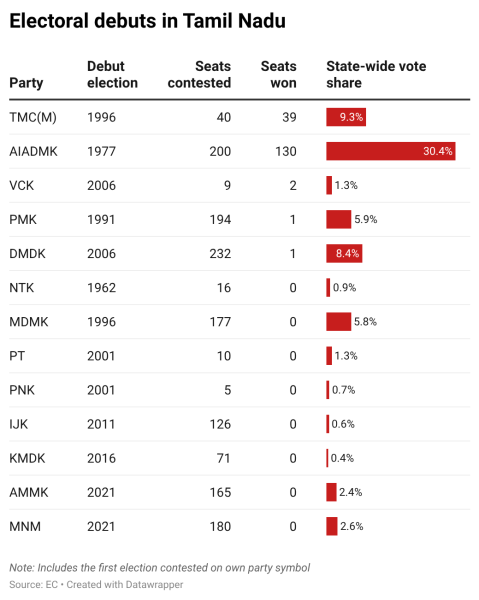 Electoral debuts in Tamil Nadu
In the revived NTK’s debut poll in 2016, it again failed to win any of the 231 seats it contested, securing just 1.06% of the overall vote share. It similarly struggled in 2021, but raised its vote share to 6.58%.
Of the 13 Tamil Nadu electoral debuts analysed, just five parties – AIADMK, Tamil Maanila Congress (M), VCK, PMK and DMDK – managed to win any seats.
Though the AIADMK contested its first election in1977, given that it was formed as a breakaway faction of the DMK, its leaders were established political figures giving it a leg up in the electoral contest. As an alliance leader then, the AIADMK had contested 200 seats, winning 130 and securing a 35.36% en route to forming its first government – making it the most successful debut in Tamil Nadu till then.
However, going by strike rates (or the share of winning seats among total contested), the G K Moopanar-founded Tamil Maanila Congress (M), also notched a hugely successful electoral debut in 1996.
Ahead of the 1996 Assembly polls, unhappy with the Congress’s decision to ally with the AIADMK, Moopanar split from the party and allied his new outfit with the DMK. Contesting 40 seats as a DMK ally, Moopanar’s party won 39 seats for a 97.5% strike rate. While the party secured 9.3% of the state-wide vote share, it received a remarkable 55.21% share of the total votes in its 40 seats.
Since 1996, the Tamil Maanila Congress (M) has contested several elections, including as an AIADMK ally, but has been unable to replicate its debut performance. This year, the party is contesting 5 seats on the BJP’s symbol as part of the AIADMK-led alliance.
Debuts in other states
Among 25 selected parties that have made their Assembly election debuts since the 1980s – ranging from the actor-turned-politician N T Rama Rao or NTR’s Telugu Desam Party (TDP) in 1983 to political strategist Prashant Kishor’s Jan Suraaj in 2025 – 11 were involved in government formation after their debuts, all but two parties managed to win at least one seat, and 11 parties won at least one-third of the seats they contested.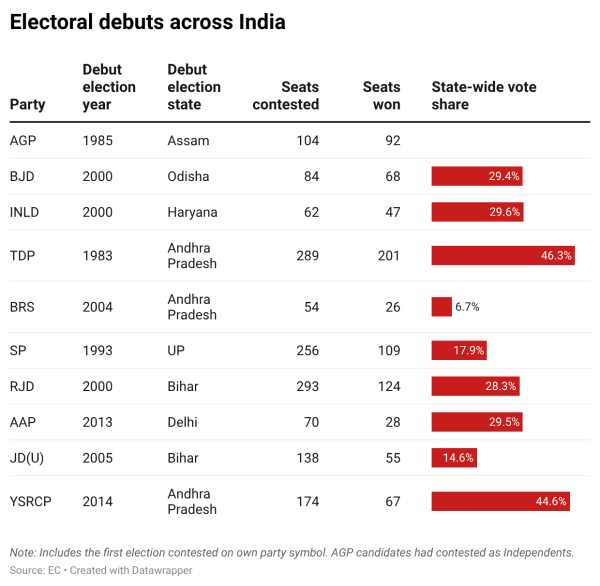 Electoral debuts India
Going by strike rates, it was the Asom Gana Parishad (AGP) that clinched a successful electoral debut, in the 1985 Assam Assembly polls. The AGP has its roots in the six-year-long student-led Assam movement over illegal immigration and culminated in the 1985 Assam Accord that led to the amendment of the Citizenship Act.
The activists of the Assam movement then coalesced into the AGP, contesting the 1985 polls with independent candidates. The AGP was able to form the government with the support of 92 Independent MLAs. The party went on to establish itself in Assam as a formidable force, returning to power in the 1996 Assembly polls and consistently winning seats in the House, more recently as a BJP ally.
Among the other successful debuts, going by strike rate, were those of Odisha’s Biju Janata Dal (BJD) in 2000 at 80.95% of contested seats won, Haryana’s Indian National Lok Dal (INLD) in 2000 at 75.81%, Andhra Pradesh’s TDP in 1983 at 69.55% and then Telangana Rashtra Samithi (now Bharat Rashtra Samithi, or BRS) in 2004 at 48.15%. Each of these parties was able to form a government on their poll debuts, either independently (in the case of the TDP) or with allies (in the case of the BJD, INLD and BRS).
A vote share analysis puts the TDP’s 1983 showing, with 46.3%, at the top, followed by the YSR Congress Party (YSRCP) at 44.6% in Andhra’s 2014 polls, the Trinamool Congress (TMC) at 30.66% in West Bengal’s 2001 polls, the INLD’s 29.6% in 2000, and the Aam Aadmi Party (AAP) at 29.61% in Delhi’s 2013 polls. Only 8 of the analysed parties secured a vote share above 20% in their electoral debuts.
Some of the more recent electoral debuts include the Prakash Ambedkar-led Vanchit Bahujan Aghadi (VBA) and Pawan Kalyan-led JanaSena Party (JSP) in the 2019 Maharashtra and Andhra Pradesh Assembly polls, respectively. The VBA had secured 4.57% of the vote share but failed to win any seats, while the JSP contested independently to win 1 seat and receive 5.53% of the vote share. While the JSP has since become a formidable presence in Andhra Pradesh, currently in the ruling government with the TDP, the VBA has struggled to carve out a space for itself in Maharashtra.