


The Rajasthan High Court has overturned a Family Court order in a matrimonial dispute from Bikaner and allowed a woman’s divorce petition.
A division bench comprising Justice Arun Monga and Justice Sunil Beniwal observed that, in matrimonial disputes, cruelty does not need to be proved “beyond reasonable doubt” as required in criminal trials.
The court said that a “preponderance of probability” is sufficient to establish cruelty in such cases. The bench also made strong observations against the ‘Aata-Sata’ marriage custom, calling it legally and morally bankrupt and describing it as an inhuman bargain involving human lives.
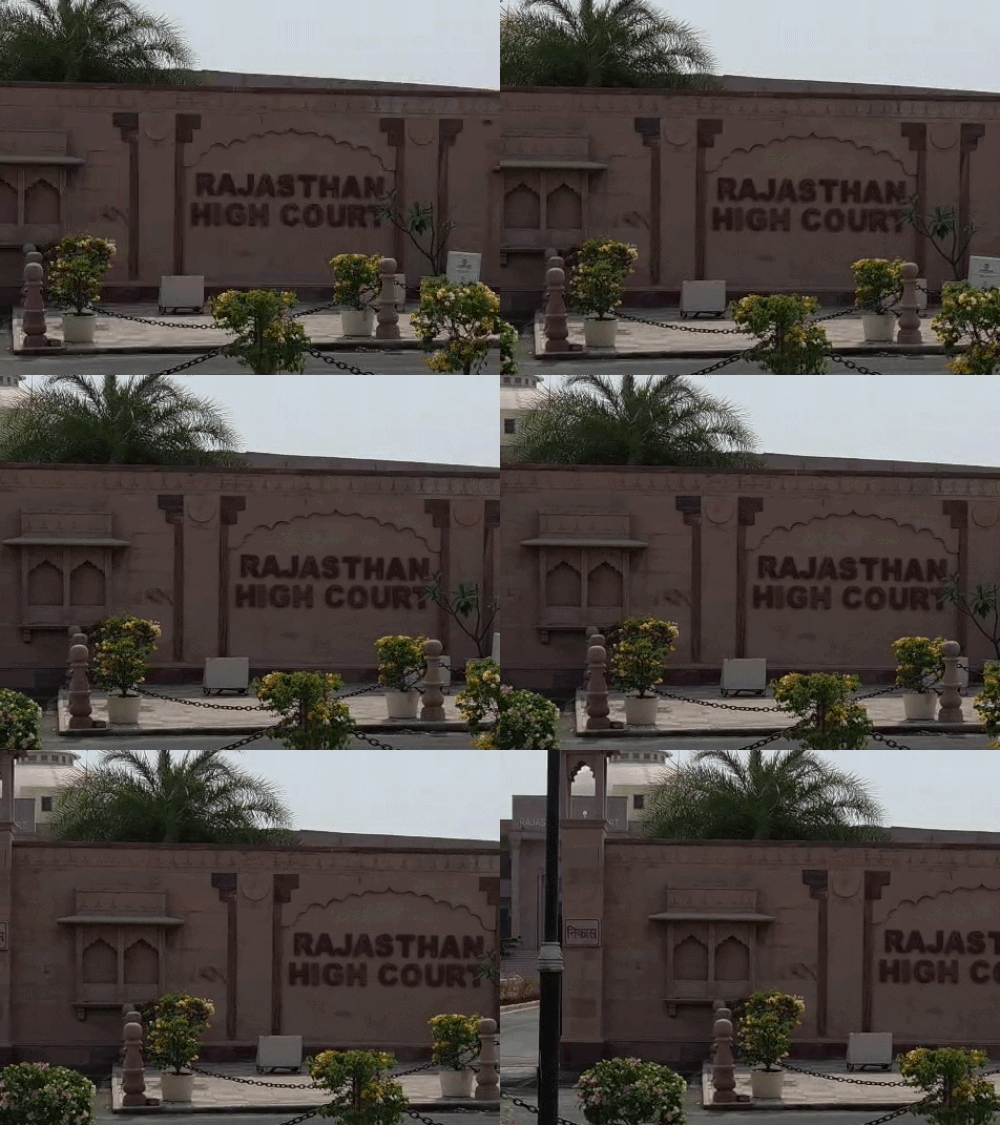
The wife argued in the High Court that she has been a continuous victim of physical and mental cruelty for dowry.
Dispute began after minor sister-in-law refused ‘Muklawa’
According to the case details, the appellant woman was married in Bikaner on 31 March 2016 as per Hindu customs. On the same day, under the ‘Aata-Sata’ custom, the husband’s minor sister was also married to the woman’s brother.
After attaining adulthood, the girl refused to accept the child marriage and declined to undergo ‘Muklawa’ (Gauna), after which disputes allegedly began between the two families. The appellant alleged that due to continued cruelty, she and her minor daughter were thrown out of the matrimonial home on 19 March 2020.
She later lodged an FIR against her husband and father-in-law alleging dowry harassment and other offences. Police subsequently filed a chargesheet against the accused.
Meanwhile, acting on the husband’s complaint, police at Nayashahar police station initiated preventive proceedings against the woman’s father and brother under Sections 107/151 CrPC for breach of peace.
Amid the ongoing dispute, the Bikaner Family Court dismissed the woman’s divorce petition on 24 September 2025.
Husband claimed wife used cases as pressure tactic
Before the High Court, the appellant wife argued that she had faced continuous physical and mental cruelty related to dowry demands. The husband, however, claimed that the woman had left the house voluntarily and that the dispute stemmed from his sister Pooja’s refusal to undergo ‘Muklawa’.
According to the husband, the wife’s maintenance and criminal cases were merely pressure tactics. The Family Court had accepted this argument while rejecting the divorce plea.
High Court says tolerance cannot be treated as consent
The High Court described the Family Court’s findings as logically flawed and said it had wrongly mixed the external family dispute arising from the ‘Aata-Sata’ arrangement with allegations of matrimonial cruelty between the husband and wife.
The bench clarified that filing a maintenance petition cannot be viewed as “undue pressure” on the husband, but should instead be seen as a defensive legal step taken by an aggrieved woman to secure her livelihood.
Wife waived alimony for ‘mental peace’
During the hearing, the wife’s counsel informed the court that she did not wish to claim any past, present or future alimony from the husband in order to maintain peace of mind.
The court recorded the statement and granted the divorce.
The bench also clarified that the divorce decree would have no impact on pending criminal proceedings or child custody matters, which would continue independently.
Court makes strong observations against ‘Aata-Sata’
Referring to the Prohibition of Child Marriage Act, 2006, the High Court made sharp remarks against the ‘Aata-Sata’ practice.
The court observed-

When marriages are arranged as a reciprocal exchange between families and one of them is a minor, the practice becomes a coercive social mechanism in which children, especially girls, are used as matrimonial barter.
The bench further stated that the practice effectively turns daughters into bargaining tools between families. The court also described the custom as a form of “matrimonial hostage”, where the future of one daughter becomes dependent on the obedience of another.
The High Court emphasised that no custom can override the law, and consent given after years of childhood conditioning cannot be considered truly free consent.