


In summers, the face starts feeling sticky and small pimples suddenly increase. In fact, as the temperature rises, the skin increases oil production to protect itself. This causes sweat to remain on the face for a long time. Due to this, pores can get blocked. In such a situation, even small pimples on the skin quickly become inflamed (swelling, redness) and turn into stubborn acne. It is not easy to control them.
In summers, the combination of sweat, bacteria, and dirt further aggravates this problem.
Therefore, today we will talk about acne that occurs in summers. We will also learn that-
- Which skin type experiences more acne in summer?
- Which habits worsen this problem?
- What are the easy ways to keep skin clean and balanced?
Expert: Dr. Sandeep Arora, Senior Consultant, Dermatology, Apollo Spectra Hospital, Delhi
What are pimples?
This is a skin condition. In this, skin pores get blocked by oil (sebum), dead skin cells, and bacteria. These usually occur on the face. They can also appear on the back, shoulders, and chest.
Are pimples and acne the same thing?
Yes, usually pimples and acne indicate the same problem, but there is a slight difference between them.
Acne is a skin condition, while pimples are a symptom of that same condition. Acne occurs when skin pores get blocked with oil, dead skin, and bacteria. In its various forms, pimples, blackheads, whiteheads, or painful large bumps appear.
Therefore, a pimple is a symptom of acne, but acne is not limited to just pimples. It can have many symptoms.
How many types of pimples are there?
Pimples are generally divided into 2 main categories-
1. Non-inflammatory
These do not have inflammation.
Blackhead – Open pores, black bumps.
Whitehead – Closed pores, white bumps.
2. Inflammatory
These have inflammation, redness, and pain.
Papule – Small, red, and sensitive bumps.
Pustule – Pimples may contain pus.
Nodule – Large, hard, and painful bumps.
Cysts- Deep, painful, and can leave scars.
Can lack of sleep and stress also increase acne in summer?
Yes, both can exacerbate acne. Let’s understand one by one why they increase acne-
Stress
- Cortisol (stress hormone) increases in the body.
- This causes oil glands to produce more sebum.
- Pores get blocked quickly, and acne increases.
Lack of Sleep
- Skin repair and healing process slows down.
- Inflammation (swelling) increases.
- Old acne heals slowly, new ones appear quickly.
Why is acne more common in summer?
In this season, sweat and skin’s oil (sebum) production increases. This blocks the skin’s pores. Additionally –
- Heat and humidity create a favorable environment for bacterial growth. Therefore, inflammation and pimples increase.
- Dust, pollution, frequent wiping of sweat, and excessive use of sunscreen or heavy products can also clog pores.
Which skin type experiences more acne in summer?
In summer, acne is most common in oily and combination skin types. Combination skin, where some parts of the face (like the T-zone: forehead, nose, chin) are oily, while other parts (like cheeks) remain normal or dry.
Why do people with oily and combination skin get more acne?
There are several reasons for acne in people with oily and combination skin. Such as-
- Their skin produces more sebum (natural oil). This increases further in summer.
- This extra oil combines with dead skin cells and dust to block pores. This leads to the formation of blackheads and whiteheads.
- Bacteria grow rapidly in clogged pores. This causes inflammation and pimples.
- In combination skin, especially the T-zone (forehead, nose, chin) is more oily. Therefore, acne is more visible in these areas.
What foods cause more acne in summer?
In summer, sweat and oil are already high. In such a situation, some foods increase the risk of acne by increasing oil and inflammation in the skin.
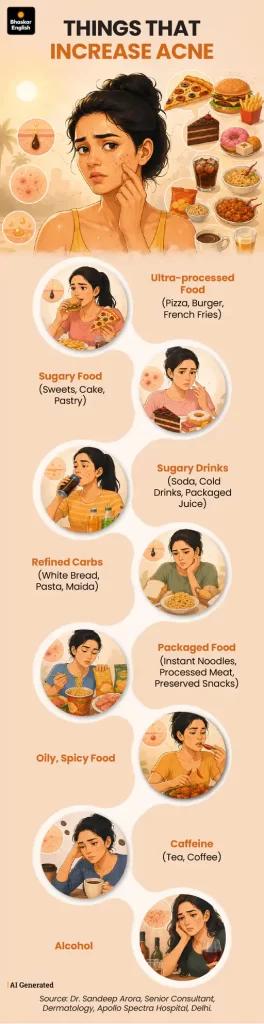
If you want to keep your skin clean and shiny, what should your food habits be like?
Correct food habits keep the skin clean, hydrated and healthy from within.

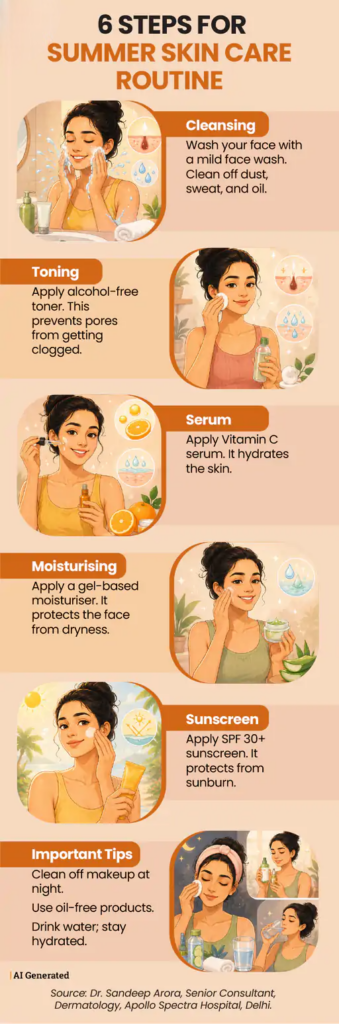
What should be the daily skincare routine in summer?
A correct daily skincare routine helps keep the skin fresh and protected. See summer skincare routine tips in the graphic-
In what situation is it necessary to see a doctor?
In some situations, it is necessary to see a dermatologist. For example-
When acne is very severe or persistent
- New pimples keep appearing repeatedly.
- Do not heal for a long time.
Painful or large pimples (nodules/cysts)
- Rashes appear with swelling.
- Pain on touch.
Scars start forming
- Scars remain after pimples heal.
- These can be permanent, so timely treatment is necessary.
Over-the-counter products don’t work
- No improvement even after using cream/facewash.
- Sudden severe acne.
If other symptoms appear with acne, such as-
- Very oily skin.
- Irregular periods (in girls).
- Hair loss or abnormal hair growth on the face.
In such cases, it is necessary to consult a doctor.
Some common questions related to acne and their answers
Can hormonal changes also trigger acne in summer?
Yes, during this time, the effect of hormones like androgens can increase in the body. These make the skin’s oil glands more active and sebum production increases. When this extra oil mixes with sweat, dust, and dead skin, pores get blocked and pimples start to form.
Does staying in AC for too long damage the skin barrier?
Yes, AC reduces humidity in the air. This causes the skin’s natural moisture to deplete rapidly. This makes the skin dry, dehydrated, and sensitive. Its protective barrier becomes weak.
Can shaving or waxing trigger pimples?
Yes, this process causes micro-cuts and irritation on the skin.
- If the razor is not clean, wrong technique is used, or oil, sweat, and bacteria accumulate in the pores after waxing, the pores can get clogged, leading to pimples or small bumps (folliculitis).
- The risk is higher in people with sensitive or oily skin.
Can hard water (tap water) increase acne?
Yes, it contains high levels of minerals like calcium and magnesium. Let’s understand with pointers-
- It leaves a layer on the skin. This layer can clog pores.
- Hard water also makes the skin dry and irritated.
- This can increase oil production. This can trigger or worsen acne.