
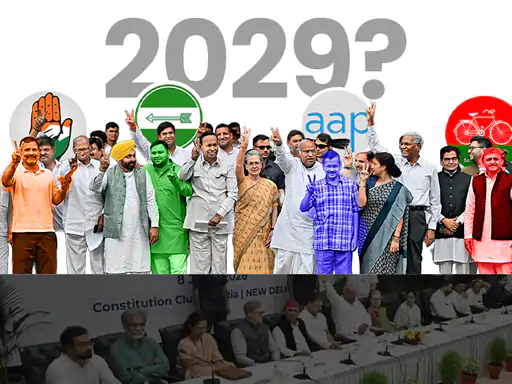
The INDIA bloc’s latest meeting on 8 June 2026 ended with a familiar message of Opposition unity, but also a familiar question: how united is the alliance really?
Of the 28 parties that came together in 2023 to challenge the BJP, only 23 attended the gathering.
With regional rivals sharing the same platform and some allies keeping their distance, can the bloc hold together long enough?
Let’s explore.
Who attended the 8th June meeting and what decisions were taken?
At the INDIA bloc’s latest meeting in New Delhi on 8 June 2026, leaders from 23 political parties participated, according to the Congress.
Some allies chose to stay away, but the bloc insisted that they had not formally abandoned the alliance.
Confirmed attendees/represented parties included:
- Indian National Congress (INC)
- All India Trinamool Congress (TMC)
- Samajwadi Party (SP)
- Rashtriya Janata Dal (RJD)
- Shiv Sena (Uddhav Balasaheb Thackeray)
- Nationalist Congress Party (Sharad Pawar) [NCP-SP]
- Communist Party of India (Marxist) [CPI(M)]
- Communist Party of India (CPI)
- Jammu & Kashmir National Conference (NC)
- People’s Democratic Party (PDP)
- Viduthalai Chiruthaigal Katchi (VCK)
Notable parties that did not attend:
- Dravida Munnetra Kazhagam (DMK)
- Aam Aadmi Party (AAP)
Main decisions after the INDIA bloc meeting
1. It was agreed that a letter will be sent to the Chief Justice of India (CJI) regarding the Special Intensive Revision (SIR), alleged manipulation of electoral rolls, and serious concerns raised about the fairness of elections.

2. It was unanimously decided to demand the immediate resignation of the Education Minister, as millions of young people who appeared for the NEET and CBSE examinations were allegedly let down during his tenure.
3. The Central government should immediately convene an all-party meeting to discuss the current serious economic situation, rising unemployment, inflation, issues concerning farmers, and other matters of public importance.
4. It was agreed that all parties of the INDIA Alliance will meet once every two months. The next meeting will be held in Hyderabad in August.
5. Parliamentary coordination will continue during the Monsoon Session, and a coordination meeting will be held every morning at the office of the Leader of the Opposition, Mallikarjun Kharge.
How did the INDIA bloc begin, and with how many parties?
The story of the INDIA bloc began not in Delhi, but in Patna.
- On 23 June 2023, leaders of 15 Opposition parties gathered at a meeting hosted by Bihar Chief Minister Nitish Kumar.
It was the first serious attempt to bring together parties that often disagreed with one another but shared one goal: challenging the BJP in the 2024 Lok Sabha election.
- A month later, at a meeting in Bengaluru, the alliance formally adopted the name INDIA, short for Indian National Developmental Inclusive Alliance.
- By then, its numbers had grown to 28 parties.
The coalition brought together the Congress, Trinamool Congress, DMK, AAP, Samajwadi Party, RJD, Shiv Sena (UBT), NCP (Sharad Pawar), Left parties and several regional outfits.
- The alliance projected itself as a broad national platform rather than a conventional coalition.
- Its leaders argued that India’s political diversity could become its strength.
Why have some parties distanced themselves from the INDIA bloc?
The biggest rupture came from Tamil Nadu.
- Recently, the DMK decided to stay away from the INDIA bloc meeting in Delhi and later announced that it was leaving the alliance.
- The immediate trigger was the Congress Party’s decision to back actor-turned-politician Vijay’s TVK after the Tamil Nadu Assembly election.
- DMK leaders accused the Congress of undermining a long-standing ally and said the move had angered party workers across the state.
But not every disagreement has led to a break-up. Former West Bengal Chief Minister Mamata Banerjee offers a different example.
- In late 2024 and early 2025, relations between the Trinamool Congress and the Congress appeared strained.
- Mamata publicly questioned the effectiveness of the alliance and, at one point, announced that her party would fight the West Bengal Assembly election on its own.
- TMC leaders also criticised Congress and Left leaders in the state, where they remain direct rivals.
- Yet, Mamata participated in the Delhi meeting and is backing efforts to keep Opposition parties together.
Differences have surfaced elsewhere too.
- Ahead of the June 2026 meeting, the CPI(M) criticised the Congress for attacking the Left government in Kerala.
- Jharkhand Mukti Morcha expressed unhappiness over the Congress announcing a Rajya Sabha candidate without wider consultation.
INDIA bloc’s troubles are rarely ideological. Most stem from state-level politics.
Parties may cooperate against the BJP nationally, but they often compete fiercely against one another at home. That has made unity difficult to sustain.
What are the biggest fault lines within the INDIA bloc?
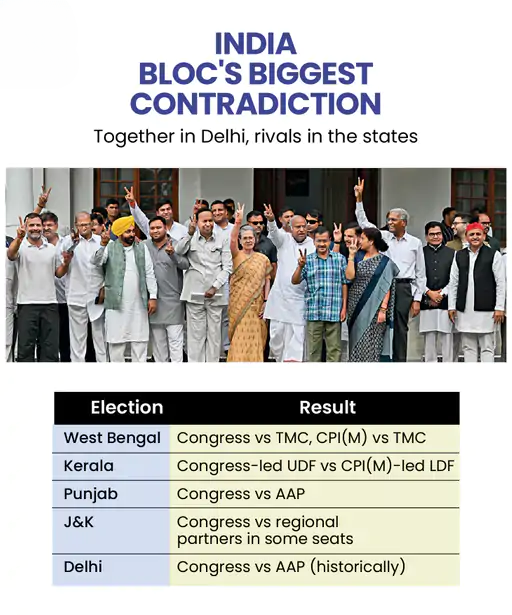
The INDIA bloc’s biggest problem is that many of its allies are rivals where it matters most: on the ground.
To understand this ground situation with more clarity, we spoke to political analyst and Founder of VoteVibe India, Amitabh Tiwari.
He argues that this is because the INDIA bloc is not a conventional electoral alliance.
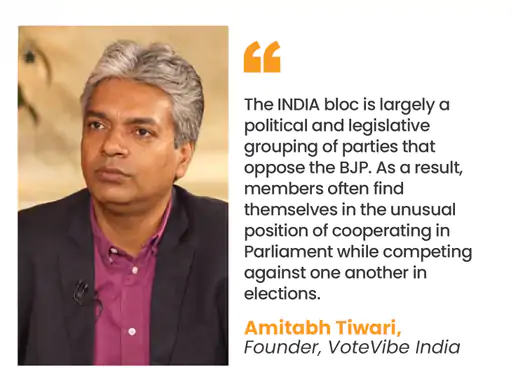
According to Tiwari, these built-in contradictions have existed since the alliance’s formation and make long-term cohesion difficult.
We also spoke to senior journalist and political analyst Rasheed Kidwai. He explains,
- In West Bengal, the Trinamool Congress battles both the Congress and the Left.
- In Kerala, the Congress-led UDF and the CPI(M)-led LDF have spent decades fighting each other.
- In Punjab, the Congress and AAP are competing for the same voters.
- The result is a strange situation: parties that stand together in Delhi often fight one another in the states.
- This contradiction is built into the alliance itself. The bloc has never clearly defined whether it is only a Lok Sabha arrangement or a broader political partnership.
- That uncertainty has repeatedly fuelled disputes over seat sharing and strategy.
Another fault line Kidwai identifies is leadership.
- Unlike the NDA, which revolves around a clear leadership structure, the INDIA bloc has no convener, no permanent office and no formal hierarchy.
- When the alliance was formed in 2023, several powerful non-Congress chief ministers, including Mamata Banerjee, Nitish Kumar, M.K. Stalin, Arvind Kejriwal and Pinarayi Vijayan, wanted to be treated as equals rather than junior partners.
As Kidwai notes, coalitions often need a dominant force to act as the engine. The INDIA bloc has never fully resolved who should play that role.
Why has the INDIA bloc struggled to mount a challenge to the BJP?
At first glance, the arithmetic appears favourable to the Opposition.
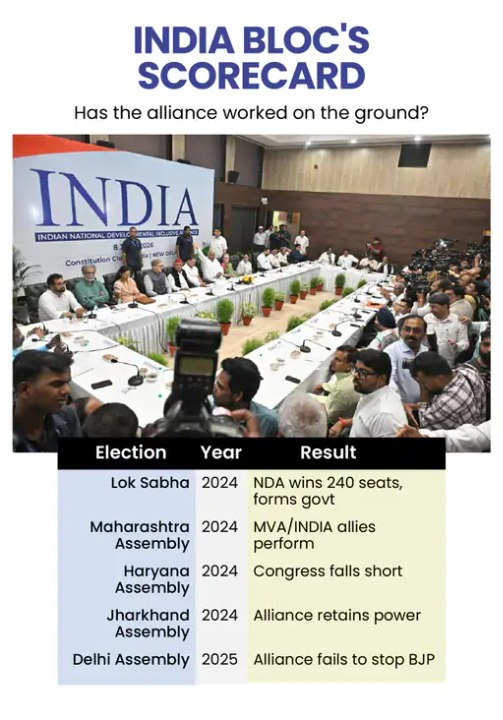
- In the 2024 Lok Sabha election, the BJP won 240 seats, well short of a majority on its own.
- Yet the INDIA bloc still failed to prevent the NDA from returning to power.
Tiwari describes the bloc as an ‘arithmetic aggregation’ rather than a deeply integrated coalition.
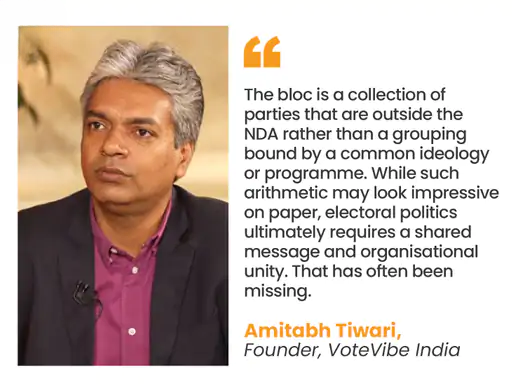
According to Rasheed Kidwai, one reason is that the alliance was created mainly to oppose Prime Minister Narendra Modi rather than to advance a shared programme.
- Unlike the BJP, which operates around a defined ideological framework, the INDIA bloc contains parties with very different priorities and voter bases.
- Beyond opposing the BJP, they have often struggled to explain what unites them.
Tiwari also points out that several INDIA bloc partners did not even contest the 2024 Lok Sabha election together in key states such as West Bengal, Kerala and Punjab.
This limited the alliance’s ability to convert anti-BJP votes into a unified electoral challenge.
Kidwai also points to a broader historical pattern.
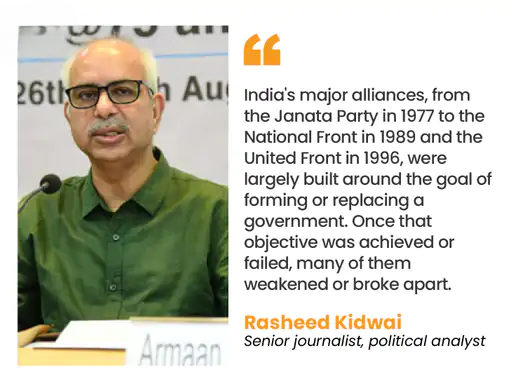
The INDIA bloc faces a similar challenge. It has been effective at bringing parties together for meetings and campaigns, but much less successful at presenting voters with a common national vision.
In politics, opposition alone rarely sustains a coalition. Voters usually want to know what comes next.
Can the INDIA bloc remain united until the 2029 Lok Sabha election?
Tiwari is less optimistic about the alliance’s long-term prospects. He notes,
- If parties struggled to contest together in 2024, maintaining unity until 2029 may prove even harder.
- State elections, leadership ambitions and regional interests could pull members in different directions over the next three years.
- Some regional parties may eventually prefer a looser third-front arrangement rather than remaining under a Congress-centric umbrella.
- Such a grouping could reduce some of the direct political competition that currently exists within the INDIA bloc.
Rasheed Kidwai adds that several basic pieces are still missing.
- The bloc has no permanent office, no common policy document, no formal decision-making structure and no agreed roadmap for handling state-level rivalries.
The seat-sharing question may become the biggest test.
- There are 543 Lok Sabha constituencies, and many alliance partners claim influence in the same regions.
- In West Bengal, for example, the Trinamool Congress, Congress and Left parties all oppose the BJP but also compete against one another.
- Similar tensions exist in Punjab and elsewhere.
- Unless these contradictions are addressed early, they could become more difficult as 2029 approaches.
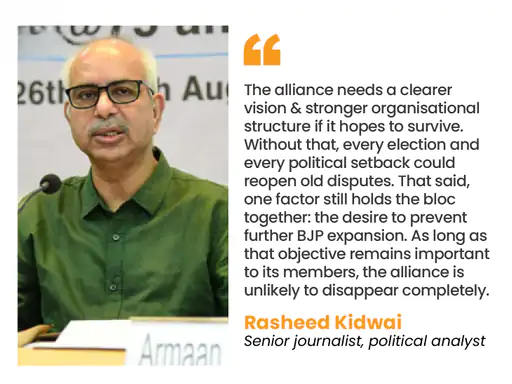
The question is whether a shared opponent is enough to keep such a diverse coalition united for another three years.