
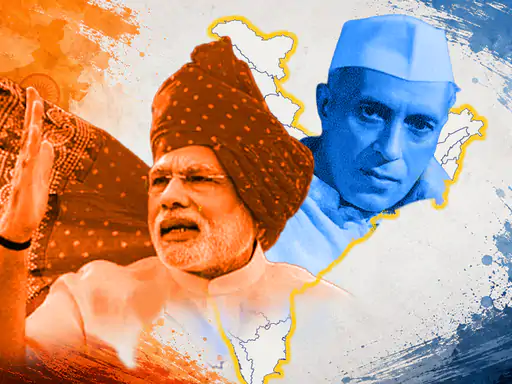
This is not just a contest of longevity.
It is a comparison between two very different Indias: one newly independent and still building its institutions, the other a complex 21st-century democracy marked by scale, ambition and contradictions.
Prime Minister Narendra PM Modi completes 4,399 consecutive days in office today on 10 June 2026, making him India’s longest continuously serving democratically elected Prime Minister, surpassing Jawaharlal Nehru’s post-election tenure of 4,398 days.
Nehru nevertheless remains India’s longest-serving Prime Minister overall, having led the country from 15 August 1947 to 27 May 1964, about 16 years and 286 days, or more than 6,100 days in office.
Yet the milestone has revived a larger question. How fair is it to compare the record of a leader who governed a nation emerging from colonial rule with one leading a mature democracy aspiring to become a global power?
Economist Dr Prabir De and international affairs expert Mohsin Raza Khan explains.
Before comparing the two leaders, it is worth answering one question:
If Nehru served longer overall, why has PM Modi break the record?
Jawaharlal Nehru served for 6,130 days as Prime Minister between 1947 and 1964, making him India’s longest-serving PM overall.
However, India did not hold its first general election until 1951–52.
The record now being discussed counts only the period after Nehru became an elected Prime Minister on 13 May 1952.
The calculation measures Nehru’s tenure from 13 May 1952, following India’s first general election, to 27 May 1964, when he died in office.
From then until his death on 27 May 1964, he served for 4,398 days. PM Modi has to surpass that figure on 10 June.
Jawaharlal Nehru
Nehru is described as having come from an elite background, educated at Cambridge, and not having worked at the grassroots level before entering politics.
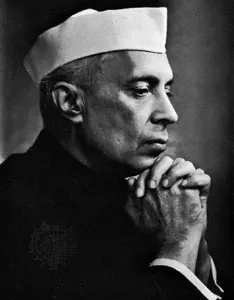
He was India’s first Prime Minister after independence, initially appointed rather than elected in a popular vote, until 1952 when the first general elections happened.
His ideology leaned towards liberal and socialist ideas, and he is often portrayed by critics as being distant from Hindu cultural traditions.
Some accounts also argue that he placed relatively less emphasis on national security, a policy approach they link to later strategic setbacks such as the 1962 conflict with China. His reported remark describing Aksai Chin as barren terrain is also cited in this context.
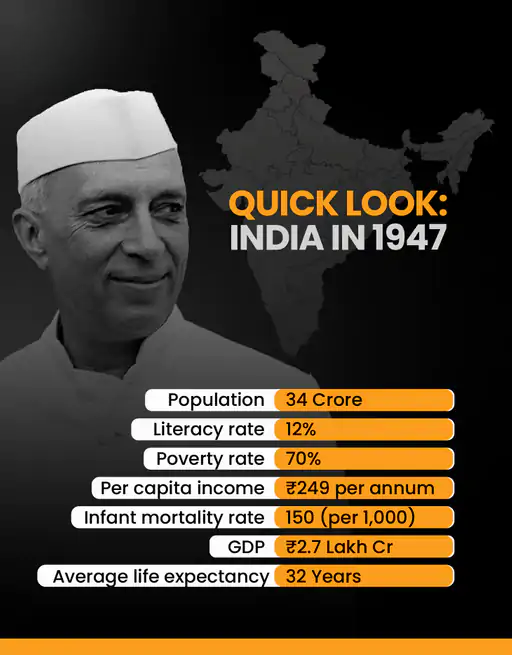
Sources: Census of India, Reserve Bank of India, World Bank, IMF.
Narendra Modi
In contrast, PM Modi is presented as coming from a modest family background, with his father working as a tea seller.
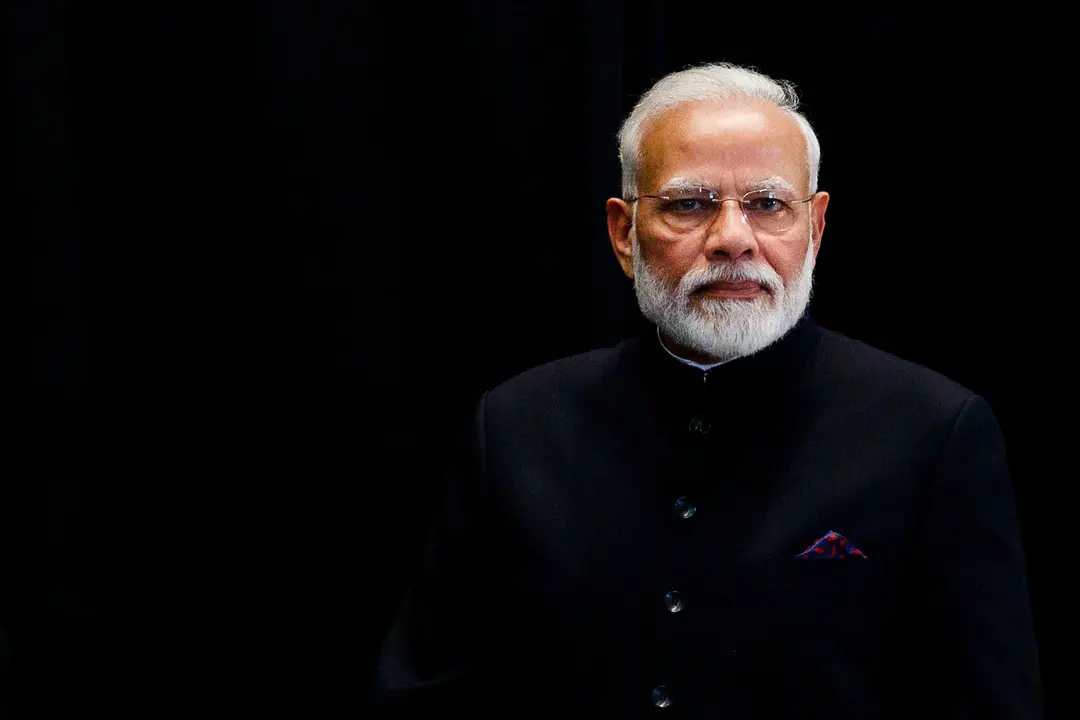
He is described as having been educated in Gujarat and spending significant years travelling across India to understand the country at the grassroots level.
His early association with the Rashtriya Swayamsevak Sangh (RSS) as a pracharak is highlighted as formative in shaping his organisational and ideological outlook.
Supporters argue that he entered national leadership through direct electoral mandate and that his governance approach reflects pride in India’s ancient cultural and civilisational heritage.
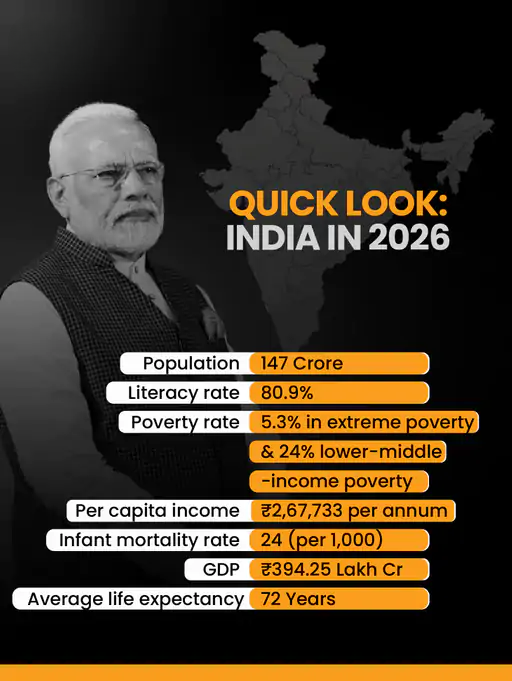
Sources: Census of India, Reserve Bank of India, World Bank, IMF.
Two visions, one nation — 9 policies that shaped India
1. Economic policy and industrial structure
Nehru was sceptical of capitalism and private enterprise, associating profit with exploitation.
His economic model built on the licence raj system discouraged private investment and fostered inefficient public sector enterprises. An anecdote attributed to him describes profit as a “dirty word,” reinforcing this perception among critics.
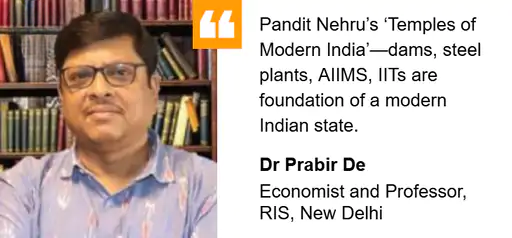
If there is one area where Nehru’s imprint is most visible, it is institution-building.
Dr Prabir De, economist and professor at the Research and Information System for Developing Countries, New Delhi, explains that the early decades of Independence saw the establishment of the IITs, AIIMS, the Planning Commission and a range of public sector enterprises that defined India’s mixed-economy model.
The emphasis was efficiency, capacity creation, often from scratch.
Dr Prabir De adds:

Nehru’s era also set the foundations of parliamentary democracy, an independent judiciary, and an Election Commission that would later evolve into one of the world’s most credible electoral institutions. These were structural investments in a state that did not exist in modern form before 1947.
PM Modi’s governance, by contrast, has largely operated on re-engineering existing institutions rather than creating foundational ones.
The expansion of digital governance, Aadhaar-linked welfare delivery, Direct Benefit Transfer, and the Unified Payments Interface, has transformed how the state interacts with citizens.
PM Modi’s economic approach is described in contrast as focused on outcomes, with an emphasis on entrepreneurship, privatisation of loss-making public sector units such as Air India, and deregulation through the removal of outdated laws.
Dr Prabir De says,
PM Modi government is credited with encouraging startups and innovation, positioning young people as potential job creators rather than job seekers.
India’s startup ecosystem is cited as exceeding 1,50,000 startups and over 100 unicorns, with funding estimated in the range of 100–150 billion dollars over the past decade.
2. National security and defence structure
In terms of national security, critics argue that Nehru placed relatively less emphasis on defence preparedness, pointing to the 1962 war with China as evidence of strategic miscalculation.
Supporters, however, contend that his government was operating under severe resource constraints while prioritising nation-building and economic development in the years immediately after Independence.
They also argue that Nehru laid the foundations of India’s security architecture by consolidating a newly independent state and establishing key defence and strategic institutions.
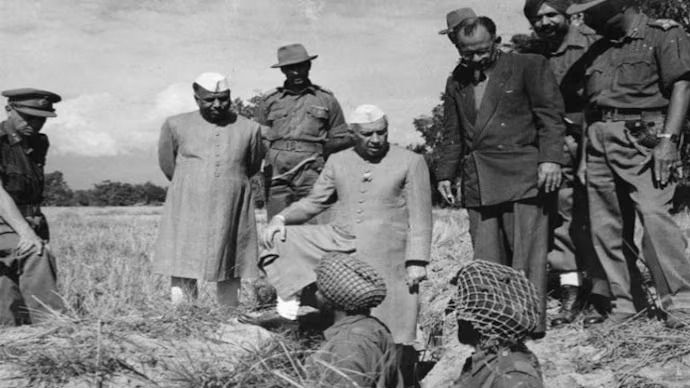
Jawaharlal Nehru at forward position where he met jawans of the Sikh unit on November 1962.
PM Modi’s tenure, by contrast, has been marked by a greater focus on defence modernisation, including the creation of the Chief of Defence Staff (CDS), reforms aimed at improving military integration, and increased participation by private firms in defence manufacturing alongside the public sector.
His government has also adopted a more assertive security posture, highlighted by actions such as the surgical strikes across the Line of Control, the Balakot air strike, Operation Sindoor, the abrogation of Article 370, and efforts to expand indigenous defence production.
Supporters view these measures as signs of a more proactive national security strategy, while critics argue that strategic challenges, particularly along the China border, continue to test India’s security framework.
3. Governance structure and policy implementation
Nehru’s governance challenge was institution-building, creating planning mechanisms, public sector enterprises, an independent judiciary, and an Election Commission that would later become one of the world’s most credible electoral institutions.
These were structural investments in a state that did not exist in modern form before 1947.
The broader governance philosophy under PM Modi is often described as a “whole of government” approach, aimed at bringing multiple departments and stakeholders together for faster decision-making.
Dr Prabir De explains,
Large-scale infrastructure projects, GST reform and digital public infrastructure are examples of this integrated approach.
4. International engagement
India’s foreign policy during the COVID-19 period is highlighted through vaccine diplomacy, often referred to as “Vaccine Maitri,” under which approximately 160 million vaccine doses were sent to around 100 countries, including neighbours and developing nations.
India’s wider humanitarian efforts, including evacuation operations and assistance during crises in different regions are also noted as part of this approach.
International affairs expert Mohsin Raza Khan argues that while Nehru’s foreign policy was rooted in non-alignment, PM Modi’s approach is better described as multi-alignment.
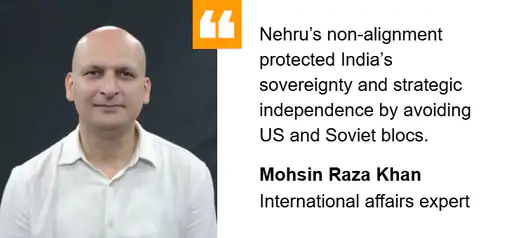
In contrast, he says PM Modi follows a multi-alignment approach, engaging simultaneously with multiple global powers and groupings to advance India’s interests through flexible, issue-based diplomacy.
5. Growth and structural change
Nehru inherited an economy weakened by colonial rule, food shortages and limited industrial capacity.
His focus was building self-reliance through heavy industry, public sector enterprises and long-term planning, growing at what economists later called the Hindu rate of growth of around 3.5% annually.
Under PM Modi, India is described as one of the fastest-growing major economies, outperforming several G20 countries.
The government highlights a reduction in multidimensional poverty by over 250 million people as a significant socio-economic transformation, and India is characterised as moving from a fragile economic position to a stronger role in the multipolar global order.
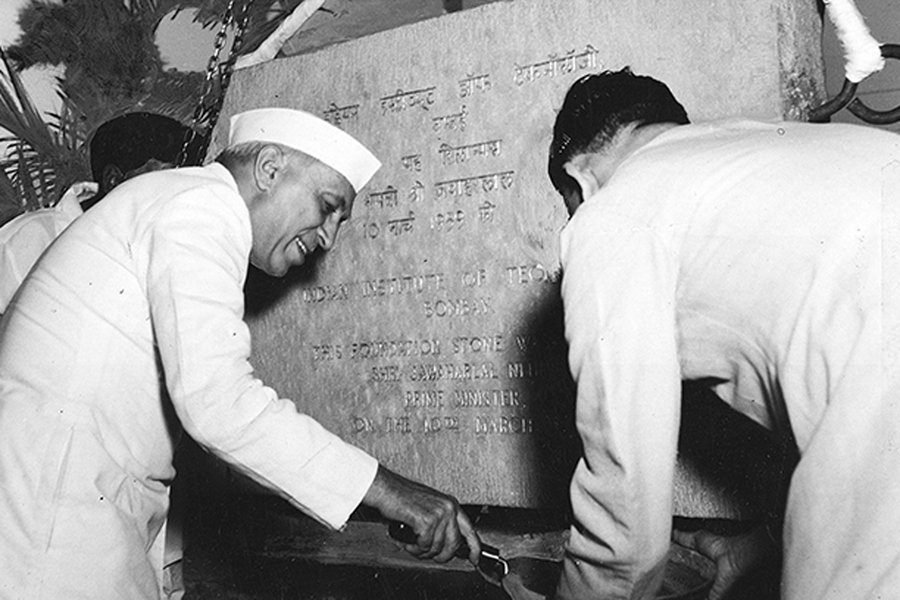
Jawaharlal Nehru laid the foundation stone for the prestigious Indian Institute of Technology (IIT) Bombay campus on March 10, 1958.
6. Digital and innovation expansion
Digital transformation was not a feature of Nehru’s era.
However, his institution-building in science, engineering and higher education laid the groundwork for India’s later technological growth.
The IITs, CSIR laboratories, Indian Statistical Institute, and INCOSPAR in 1962 were early seeds of this foundation. Under PM Modi, the Digital India programme launched in 2015 gave this a formal policy push.
Internet users grew from around 250 million in 2014 to nearly 1 billion by the mid-2020s. Average data usage per user rose sharply.
UPI today is the world’s largest real-time payments system, processing over 100 billion transactions annually. India has also grown into the third largest startup ecosystem globally.
7. Cultural diplomacy and heritage positioning
Nehru promoted India’s global image through cultural institutions.
Maulana Abul Kalam Azad founded ICCR in 1950, with Nehru expanding its reach beyond Asia to project India as a plural and secular civilisation.
The Sangeet Natak, Sahitya and Lalit Kala Akademis were set up in 1954 to preserve arts, literature and fine arts.
PM Modi shifted toward civilisational heritage as soft power. International Yoga Day was adopted by the UN in 2015. India’s millet push during the G20 presidency led to the International Year of Millets 2023.
Nalanda University was revived as a symbol of ancient learning. The new Parliament was inaugurated in 2023 with a religious ceremony reflecting a deliberate cultural statement.
However, a 2022 Parliamentary Standing Committee report flagged inadequate financing, lack of coordination and shortage of skilled manpower as limitations still holding back India’s cultural diplomacy.
8. Nationalism
According to political analyst Amitabh Tiwari, Nehru’s model centred on a secular, plural democracy built on constitutional institutions.
While Modi’s approach emphasises civilisational pride, cultural unity, and reclaiming India’s Indic heritage beyond colonial legacies.
9. Religious Stand
Nehru was a committed secularist who believed religion had no place in state affairs. He resisted pressure to declare India a Hindu nation despite Partition occurring on religious lines.
He opposed state funding for Somnath temple reconstruction, backed Hindu Code Bill reforms in 1955-56 giving women equal rights in marriage, divorce and inheritance, and supported Article 44’s vision of a Uniform Civil Code.
India was established as a secular republic, with the word secular formally added to the Preamble in 1976 under Indira Gandhi. Critics argue Nehru’s model of secularism was selective and contributed to vote-bank politics over time.
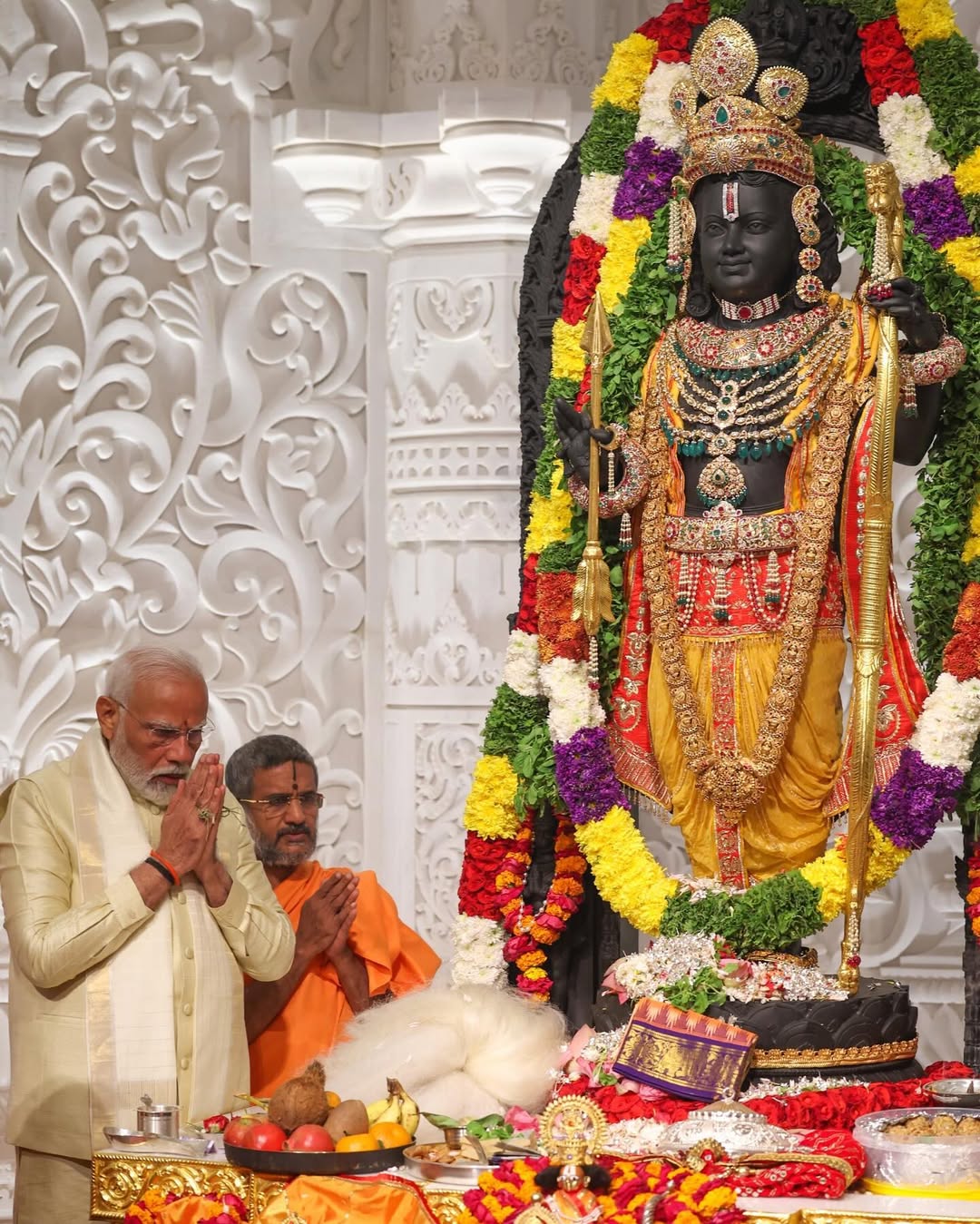
Narendra PM Modi leads the sacred Pran Pratishtha at Ram Mandir, Ayodhya, 22 January, 2024.
PM Modi is often seen as the political face of contemporary Hindutva. His government scrapped triple talaq in 2019 and passed the Citizenship Amendment Act granting citizenship on religious grounds to persecuted minorities from three neighbouring countries excluding Muslims, though full implementation remains limited since rules were notified only in March 2024.
His tenure also saw the Ram Mandir inauguration in Ayodhya in January 2024, Kashi Vishwanath Corridor in 2021, Ujjain Mahakal Corridor in 2022, and the new Parliament inauguration in 2023 with the Sengol sceptre from Tamil Hindu tradition.
Supporters say these moves restore historical wrongs and cultural pride. Critics argue they shift India from constitutional secularism toward majoritarian governance.