

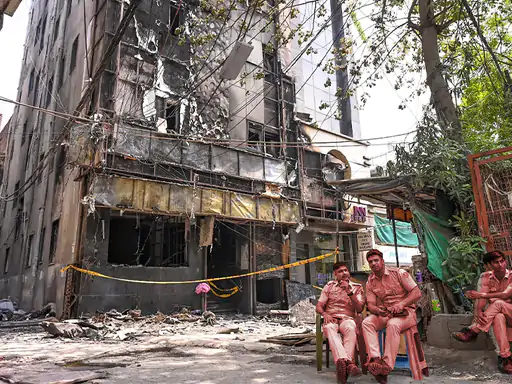
5 June 2026 | Noida high-rise residential fire
A fire broke out around 8 am at Ivy County Society, Sector 75, Noida, in a 12th-floor flat of a 28-storey tower. The blaze spread rapidly, with flames and thick black smoke visible across nearby areas.
4 June 2026 | Bihar ICU Fire
A suspected short circuit triggered a fire in the ICU of a private hospital in Muzaffarpur, Bihar, killing five patients.
3 June 2026 | Delhi Hotel Fire
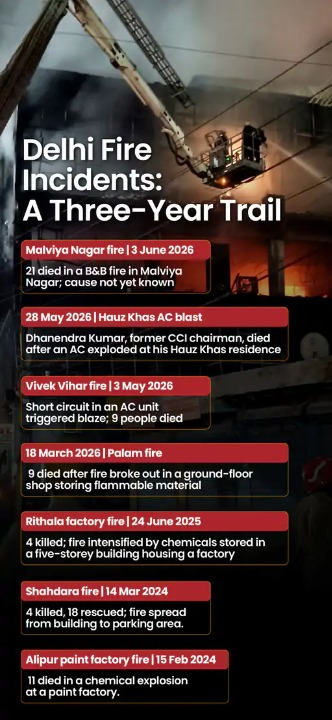
A fire that reportedly started in the basement restaurant or kitchen of a hotel in Delhi’s Malviya Nagar killed 21 people, including tourists.
3 May 2026 | Delhi Vivek Vihar Residential Fire
A suspected short circuit in an air-conditioning unit triggered a late-night fire in a residential building in Vivek Vihar, Delhi, killing nine people and injuring four.
18 March 2026 | Delhi Palam Building Fire
A suspected short circuit in a ground-floor shop triggered a fire in a four-storey building in Palam, Delhi, killing nine people and injuring several others.
16 March 2026 | Odisha Hospital ICU Fire
suspected short circuit triggered a fire in the Trauma Care ICU of SCB Medical College in Cuttack, Odisha, killing at least ten patients..
And the list goes on…
India’s recent spate of fire tragedies, from hospitals and hotels to residential buildings, points to a troubling and recurring pattern.
Whether it is missing fire safety clearances, faulty electrical systems, unauthorised construction, or weak enforcement of building norms, these incidents repeatedly expose systemic gaps rather than isolated failures.
The result is a series of preventable disasters that continue to claim lives across the country, raising urgent questions about compliance, accountability, and oversight.
In this story, we explore why such tragedies keep happening, where the system is failing, and the safety checks people should make before entering public spaces.
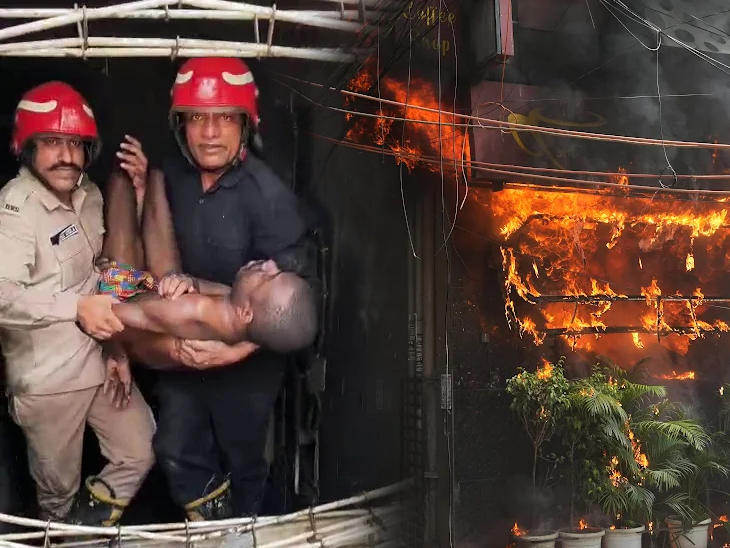
The building in the Malviya Nagar area which caught fire allegedly operated as a bed-and-breakfast catering to patients and relatives of those receiving treatment at a nearby private hospital.
Why do fire incidents keep recurring in India?
The answer is something many Indians are already aware of, yet such incidents continue to repeat like Bollywood’s ‘Tarikh pe tarikh’.
Nevertheless, the deadly blaze in South Delhi on 3 June 2026 has once again exposed recurring fire safety gaps in India’s urban spaces, especially weak preparedness culture and fragile institutional response systems.
Residential areas still account for the largest share of fire-related fatalities in the country.
A key factor is poor compliance with building by-laws and planning regulations, especially in urban centres. The 3 June fire in densely populated Malviya Nagar occurred in a hotel originally built as a residential structure, later extensively modified and expanded without adequate safety compliance.
Together, regulatory lapses, weak enforcement, and poor safety awareness explain why fire incidents continue despite repeated warnings and past tragedies.
What common safety lapses are being found in all fire tragedies?
Investigations repeatedly show a familiar pattern of systemic failures in commercial buildings and public facilities.
Blocked or locked exits are common, emergency staircases and escape routes are often obstructed with goods, furniture, or locked, making evacuation difficult or impossible.
Poor electrical maintenance is another major issue, with fires linked to faulty wiring, overloaded circuits, uninspected transformers, or unsafe extension use.
Missing or non-functional fire safety systems are frequent, smoke detectors, alarms, and sprinklers are absent, unmaintained, or have dead batteries, delaying detection and evacuation.
Many buildings also lack valid Fire Safety No Objection Certificates (NOCs) or violate National Building Code requirements.
Unsafe storage of flammables (gas cylinders, chemicals, combustibles) in basements, stairwells, or near heat sources further increases risk.
Poor emergency preparedness, lack of signage, drills, or training, leads to panic and sometimes deadly evacuations.
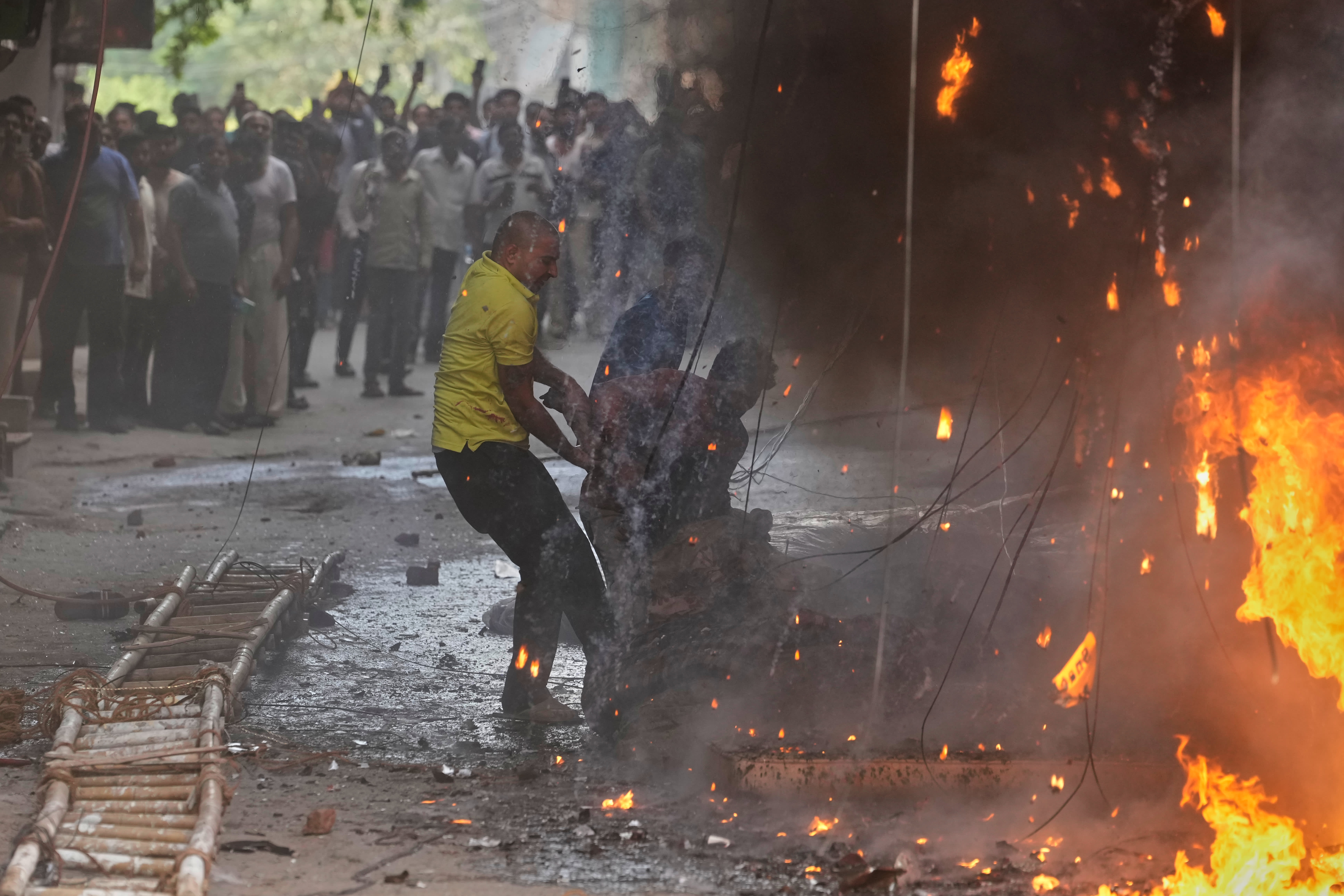
Locals helped rescue a foreign national from a hotel fire in New Delhi on 3 June.
How different is the Delhi hotel fire incident from the Goa’s Romeo Lane case?
The Delhi hotel fire and the Goa Romeo Lane incident differ in location, type of establishment, and how the aftermath unfolded, even though both involved major fire safety lapses and high death tolls.
Venue and nature of incident
Delhi hotel fire: Took place at a ground-plus-five-storey bed-and-breakfast/hotel in Malviya Nagar, South Delhi. The blaze led to 21 deaths, including 11 foreign nationals.
Goa Romeo Lane case: Occurred on December 6, 2025, at the Birch by Romeo Lane nightclub in Arpora, North Goa. The fire broke out during a late-night party and is believed to have been intensified by fireworks or a cylinder explosion, resulting in 25 deaths, including 20 staff members and 5 tourists.
Regulatory violations and operations Delhi: The property was reportedly functioning as a B&B with allegations of illegal structural additions and missing fire safety approvals, raising questions about oversight by local civic and fire authorities.
Goa: The nightclub was operating without essential safety clearances and reportedly lacked adequate emergency exits. Its narrow-lane location further obstructed rescue efforts.
Owner action and legal fallout Delhi: The owner allegedly fled after the incident and was later being pursued by authorities.
Goa: The owners of the club, the Luthra brothers, reportedly escaped to Thailand soon after the fire but were later deported back to India, where they faced charges including culpable homicide and negligence.

When fire broke out at Goa’s Romeo Lane nightclub on 6 December 2025, a belly dancer reportedly continued performing on the dance floor.
What do India’s fire safety laws say?
Fire services fall under the 12th Schedule of the Constitution (Article 243W) and are managed by states, UTs, and Urban Local Bodies, with varying structures across regions.
The Standing Fire Advisory Committee (1956, renamed Council in 1980) includes state fire services and central ministries like Home Affairs, Defence, Transport, IT, and BIS.
Key gaps remain: weak training systems, poor equipment, inadequate funding, low awareness, irregular drills, missing assessments, and lack of uniform fire laws in several states.
Recommended response time is 3–5 minutes in cities and up to 20 minutes in rural areas, but shortages remain severe—about 97% fire stations, 80% fire vehicles, and 96% fire personnel gaps.
Fire safety is also governed by the National Building Code 2016 (Part 4), covering fire prevention, evacuation norms, building design, fire zones, and protection systems.
Under Model Building Byelaws 2003, Fire Safety NOC from the Chief Fire Officer is mandatory, and occupancy certificates require full compliance.
Why are illegal constructions allowed?
Illegal constructions persist due to weak enforcement, socio-economic pressures, and political-administrative complicity.
The Observer Research Foundation notes they include encroachments, building violations, environmental breaches, fire safety violations, and urban rule violations, with uneven enforcement influenced by discretion and local pressure.
Corruption and political patronage allow bypassing approvals and safety norms, often weakening municipal action through intervention.
Rapid urbanisation and lack of affordable housing push migrants into informal settlements, later partially tolerated or regularised for humanitarian and political reasons.
Urban bodies also face capacity constraints, limiting enforcement against widespread violations. Over time, regularisation through penalties has weakened deterrence, encouraging “violate first, comply later” behaviour.
EVERY TRAGEDY, THE SAME QUESTIONS
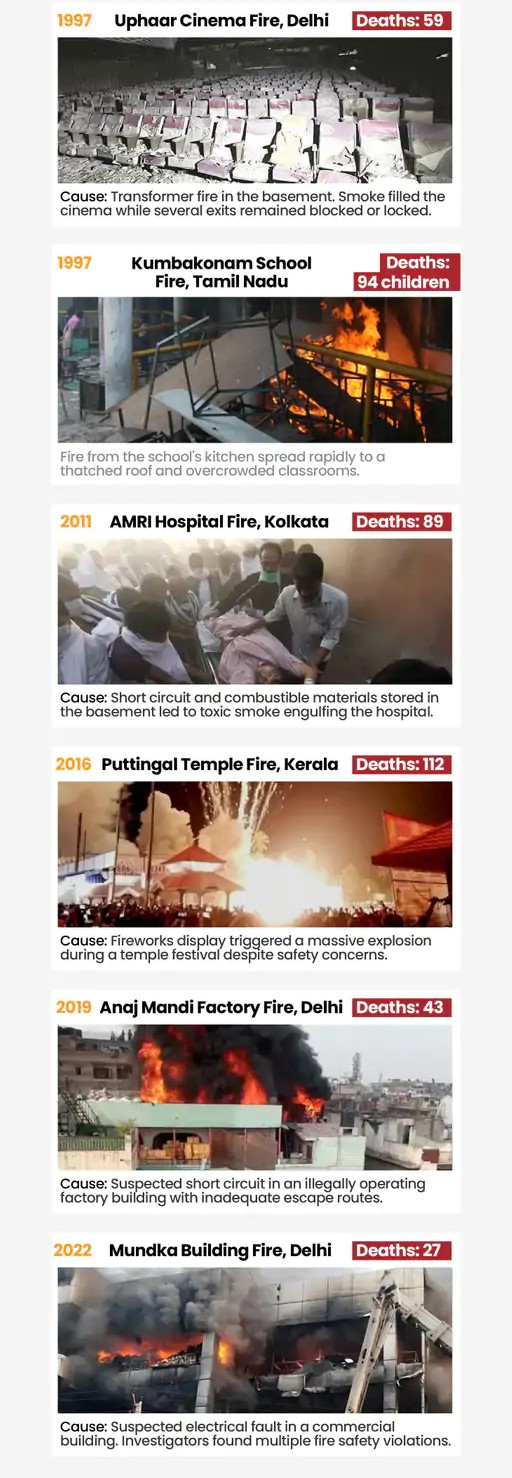
Is hotel safety the government’s responsibility alone, or should travellers also check for it themselves?
Responsibility is shared. While enforcement, inspections, and compliance systems can be weak in many places, guests also have a right—and practical need—to observe basic safety conditions.
Experts suggest quick personal safety checks on arrival: locate emergency exits, ensure they are marked and clear, look for evacuation maps near lifts or doors, and note assembly points and security/help desks.
In rooms, check locks, deadbolt, chain, peephole, and review nearest stairwell via floor plans on doors. Ensure windows can open if needed for escape. Confirm in-room safes work.
General awareness also matters, stay alert to unusual conditions and maintain basic privacy precautions like closing curtains.
In essence, systems must ensure safety, but individual vigilance adds an extra layer of protection.
What should you do if all escape routes are blocked during a fire?
If all exit routes are blocked during a fire, take the following steps:
Stay in the room you are in and close the door.
Seal gaps around the door, windows or vents facing the fire with wet towels, sheets or clothing to help prevent smoke from entering.
If you can safely reach a window that opens to the outside, open it slightly to let in fresh air.
Signal for help from the window by waving a cloth or sheet, and use a torch or your phone’s flashlight to attract attention.
If your phone is working, immediately call the fire service, police or emergency services. Clearly explain that you are trapped and provide your exact location.
What should you never do if trapped in a fire inside an enclosed space?
If you are trapped in a room, office, flat or other enclosed space during a fire, avoid the following:
- Do not panic or run around aimlessly.
- Do not go back into the fire area to collect belongings such as phones, money or documents, or to search for others.
- Do not use lifts.
- Do not switch electrical appliances, lights or gas systems on or off.
- Do not jump from a window without protection or assistance. Only consider it as a last resort if the height is low and there is no safer option.
- If there is heavy smoke or fire in the corridor or adjoining room, avoid repeatedly opening the door, as this can allow smoke and flames to spread more quickly
.
How do other countries prevent building fire tragedies?
Countries reduce fire tragedies through strict codes, early detection, suppression systems, inspections, and strong enforcement focused on rapid evacuation and fire containment.
Compartmentation is key, fire-resistant materials, fire-rated walls, and automatic doors limit spread. Sprinklers and water mist systems control early fires, while smoke/heat alarms enable quick alerts. Some places like Dubai use real-time monitoring for rapid response.
EU countries and Australia use performance-based fire safety engineering for flexible but safe design.
Japan mandates regular fire drills under strict oversight.
Examples: the UK enforces fire risk checks and post-Grenfell upgrades; the US follows NFPA standards with sprinklers, alarms, drills, inspections; Japan combines fire-resistant design with drills; Singapore enforces strict inspections and penalties; Germany embeds safety in compartmentalised design and fire-resistant materials.
Across countries, the core remains the same: strong laws, strict enforcement, built-in safety systems, and regular preparedness.