


One woman was pregnant. Another had just seen both families ‘settle’ the dispute.
Within hours, both were dead under suspicious circumstances linked to dowry, pressure and humiliation.
In Twisha Sharma’s case, her husband allegedly questioned the legitimacy of his wife’s unborn child.
In Deepika Nagar’s case, her family, which had already spent nearly ₹1 crore on marriage, allegedly kept facing fresh demands.
When DNA tests, divorce laws, police complaints and courts already exist, why do so many such stories still end with a woman losing her life? Let’s explore.

Left: Twisha Sharma, 33, from Noida, was found dead at her matrimonial home in Bhopal’s Katara Hills area. Right: Deepika Nagar, 26, from Greater Noida, died after falling from the third floor of her in-laws’ house in Greater Noida.
Why was the legitimacy of Twisha’s pregnancy questioned in the first place?
- In many Indian marriages, a woman’s character is still tied to ideas of ‘family honour’, sexual purity and control over her body.
- That is why pregnancy itself can become a trigger for suspicion, especially in toxic marriages already facing fights over money, dowry or trust.
- In Twisha’s case, reports suggest her husband questioned whether he was the father of the unborn child. Such accusations are not rare.
- Across India, women in abusive marriages are often subjected to surveillance, phone checking, accusations of affairs and public humiliation.
- Sometimes it begins with ordinary marital fights.
- Then the suspicion slowly becomes emotional torture.
- The cruelty is deeper because pregnancy is usually the time when women are physically and emotionally most vulnerable.
- Instead of support, some women face isolation and blame.
- Researchers studying dowry deaths and domestic violence say patriarchy and the need to ‘control’ women remain major causes behind such abuse.
- Even today, many families see a woman not as an equal partner, but as someone whose loyalty must constantly be proved.
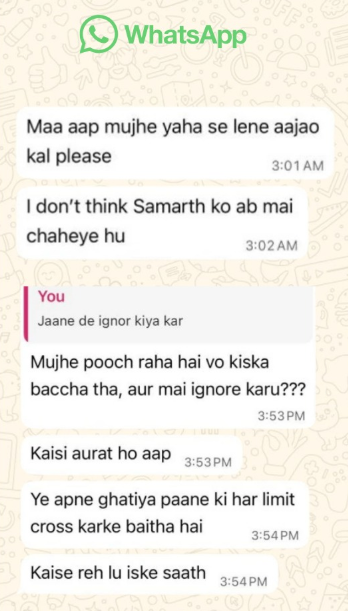
In messages sent before her death, Twisha Sharma begged her mother for help, saying her husband was questioning the legitimacy of her unborn child. (Screenshot from Twisha’s mother’s WhatsApp chat)
If the legitimacy was in doubt, why did her in-laws not get a DNA test?
That is the question many people asked after Twisha’s death.
- If there was genuine doubt, science already offers a legal answer.
- DNA testing can establish paternity with very high accuracy.
- But in India, such accusations are often less about finding the truth and more about humiliating the woman.
- In many domestic abuse cases, allegations about ‘character’ become tools for control.
- The purpose is emotional pressure, not resolution.
There is also a legal complication.
- Indian courts do not allow routine DNA tests merely because a husband suspects infidelity.
- Courts have repeatedly said paternity tests cannot be ordered casually, especially if they may damage the dignity of the woman or child.
- A husband usually has to show strong evidence before such a test is allowed.
- But even outside court, couples can voluntarily undergo private DNA testing if both sides agree.

If the families wanted dowry, why did they not choose divorce instead?
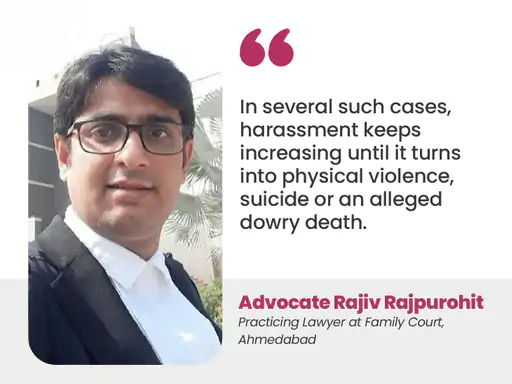
According to Advocate Rajiv Rajpurohit, an Ahmedabad-based divorce lawyer who has also been associated with the Supreme Court of India,
- Such cases usually do not begin with a planned intention to kill.
- The pressure builds slowly through repeated demands, fights and emotional abuse.
- Dowry demands are often disguised as ‘help’ for business losses, loans or financial trouble.
- Many parents agree at first because they believe it will ‘save’ their daughter’s marriage.
- But once expectations are set, tensions start growing when the demands are not met again.
Raijv explains,

As per my understanding, it happens slowly and gradually with symbolic symptoms. They do not suddenly decide to kill one day.
According to him,
- Families often fail to understand how serious the situation has become until violence escalates.
- Many offenders act without thinking about legal consequences.
- At that point of time, they fail to understand what the consequences will be.
Do men and their families think they can get away with murder so easily?
The problem is not simply ‘confidence’ about escaping punishment.
The bigger issue is that violence inside homes often goes unnoticed until it is too late.
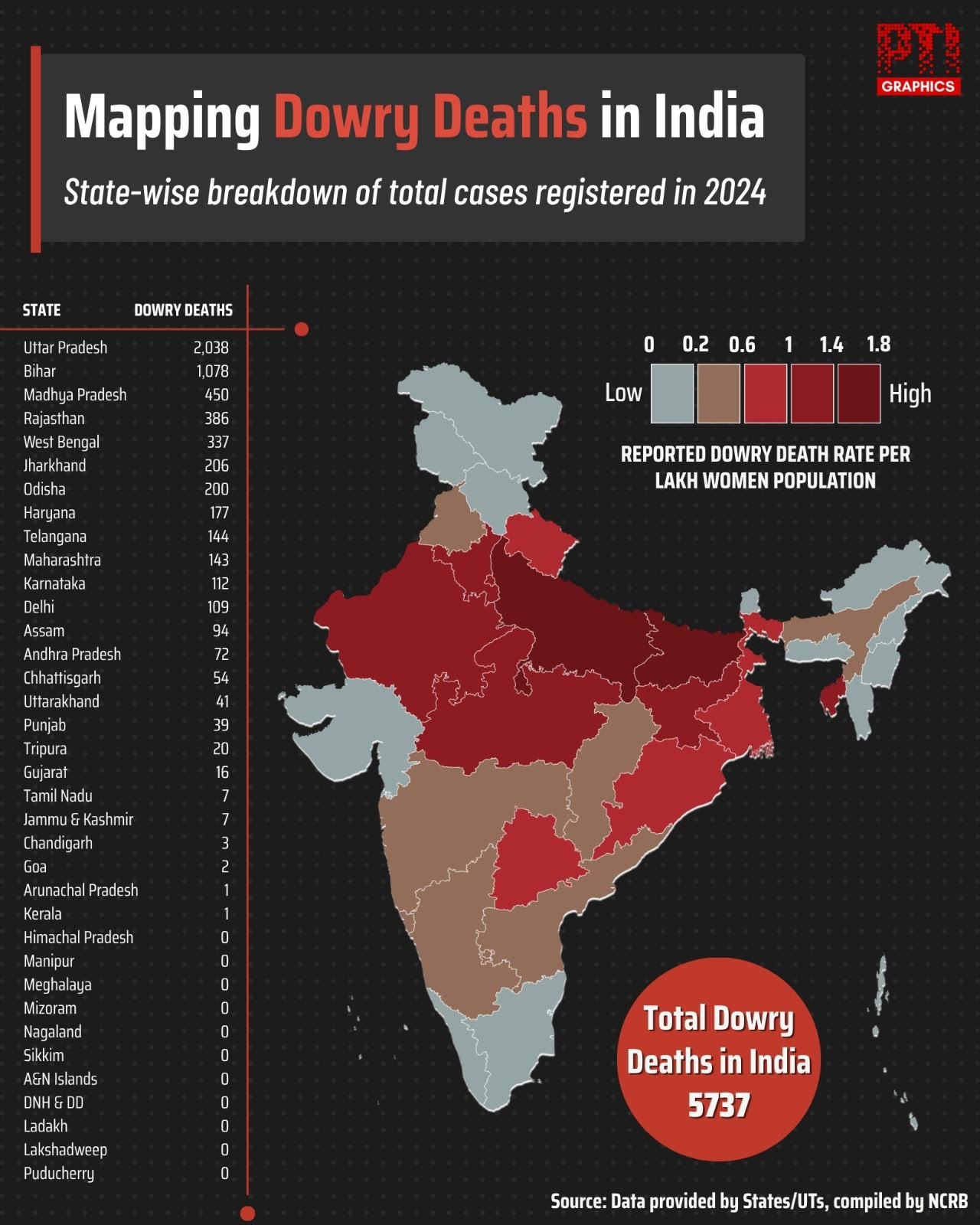
- According to the National Crime Records Bureau (NCRB), India recorded 5,737 dowry deaths in 2024 alone.
- That means nearly 16 women died every day in cases linked to dowry harassment.
- Uttar Pradesh and Bihar reported the highest numbers.
- At the same time, thousands of cases remained stuck in courts for years. This delay matters.
- In many homes, abuse becomes normalised long before police ever enter the picture.
- Neighbours stay silent. Relatives call it a ‘personal matter’. Families try to ‘adjust’.
- By the time a woman dies, there may already have been months or years of threats, beatings or humiliation.
- Another problem is that many deaths are initially presented as suicide, accidents or sudden illness.
- Evidence can disappear quickly. Bodies may even be cremated early.
That does not mean offenders always escape.
But the social silence around domestic violence often gives abusers the confidence that nobody will intervene in time.
Why did the women’s families fail to help them in time?
This is one of the hardest questions in such cases.
- Most families do not knowingly send daughters back into danger.
- But many still underestimate how serious the abuse has become.
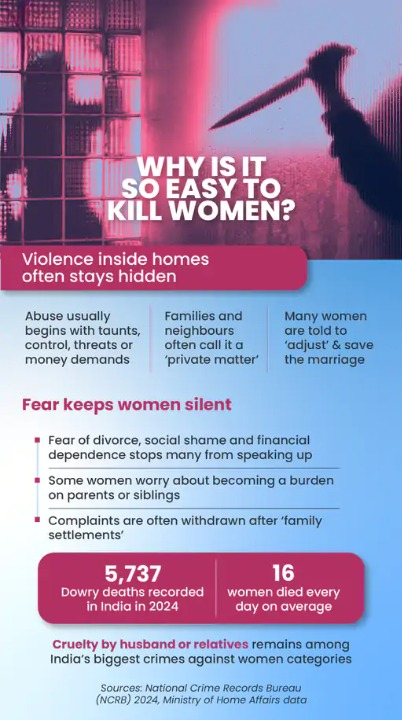
- In India, marriage is often treated as something a woman must ‘save’ at any cost.
- Parents fear social shame, divorce, gossip and the future of children.
- So when disputes begin, families frequently try to compromise first.
- They arrange meetings, pay money, involve relatives or ask the woman to ‘adjust for some time’.
That appears to have happened in Deepika Nagar’s case too.
According to her family, discussions had taken place shortly before her death to settle the dispute. Hours later, she was dead.
Financial dependence is another reason.
- Many women do not have independent income or safe housing outside marriage.
- Returning home permanently may itself feel impossible.
The tragedy is that warning signs are often visible much earlier.
NCRB data has repeatedly shown that cruelty by husbands and relatives remains one of the largest categories of crimes against women in India.

Deepika Nagar’s family says they gave a Mahindra Scorpio-N, ₹5.71 lakh in cash, 16 gold rings and gold jewellery at her wedding. They allege her in-laws later demanded a Fortuner and ₹50 lakh more, and harassed her over it.
How can women escape in such situations?
Rajiv Rajpurohit says the biggest problem is silence. According to him,
- Many women continue adjusting because they fear social stigma, financial dependence and the collapse of their marriage.
- They often hesitate to even tell their parents the full truth.
- Some fear becoming a ‘burden’ on their family.
- Others worry about children, society or what relatives will say.
Rajiv says,
The human mind is somewhere very complex. Women start accepting this thing at a time when they should actually communicate about it and seek help.
According to Rajpurohit, the first step is speaking up early.
- Women should approach police, lawyers or support systems as soon as harassment begins instead of waiting for things to worsen.

- Rajiv also stresses the need for anonymous support spaces and counselling systems where women can safely report abuse.
- He believes families and authorities must learn to recognise warning signs before violence escalates.
Rajiv emphasises,
Time is always of the essence. We can only stop this if we act on time. Otherwise, it will continue happening.