
The Supreme Court on Monday heard the case related to the death of actress Twisha Sharma, a model and actor who was found hanging at her marital home on May 12 – barely five months after her marriage to Samarth Singh.
During the hearing, the bench headed by Chief Justice of India Surya Kant remarked that certain developments in the case had caused concern. He appealed to the media to avoid aggressively pursuing statements from either the victim’s family or the accused side and allow the legal process to proceed according to law.

Meanwhile, Solicitor General Tushar Mehta, appearing for the Madhya Pradesh government, alleged that Twisha’s mother-in-law and former judge Giribala Singh was creating obstacles in the investigation.
Why the Supreme Court took up the matter suo motu
During the proceedings, Chief Justice Surya Kant explained why the Supreme Court had initiated suo motu action in the matter.
He referred to a report published by India Today on May 18 that raised questions about alleged institutional bias and procedural irregularities in the investigation.
According to the Chief Justice, concerns were raised regarding the fairness of the probe because the deceased actress’s husband is a lawyer and her mother-in-law is a former district judge.
The report questioned whether undue influence could have affected the investigation and suggested that involvement of judicial connections may have impacted impartiality.
The Chief Justice stated that these concerns prompted the Supreme Court to initiate proceedings on its own.
Solicitor General says attempts being made to tarnish Twisha’s image
Solicitor General Tushar Mehta argued before the court that the former judge was appearing on multiple television channels and attempting to damage the image of the deceased actress.
He stated:

“The moral essence of this entire story is that being a divorced daughter is far better than being a dead daughter.”
Defence raises questions over delay in FIR
Senior Advocate Siddharth Luthra, appearing for Giribala Singh, argued that there was a three-day delay in registering the FIR.
He also alleged negligence in preserving evidence related to the case.
Luthra stated that Twisha’s mother-in-law herself was voluntarily presenting her own call detail records before investigators.
High Court hearing on bail plea may be deferred
The Madhya Pradesh High Court is scheduled to hear petitions seeking cancellation of the anticipatory bail granted to retired district judge Giribala Singh by a Bhopal district court.
The petitions were filed by the Madhya Pradesh government and Twisha Sharma’s father.
The matter is listed before Justice Devnarayan Mishra and is likely to be heard after lunch.
Meanwhile, the Bhopal district court will hear an application seeking preservation of call detail records of Samarth Singh and Giribala Singh from May 12 to May 20, along with CCTV footage from AIIMS Bhopal.
Advocate Pankaj Dubey said the High Court hearing on Giribala Singh’s bail could be postponed as the court may wait for directions from the Supreme Court.
Twisha’s in-laws have maintained that the actress died by suicide, while her parental family has accused her husband and in-laws of murder.
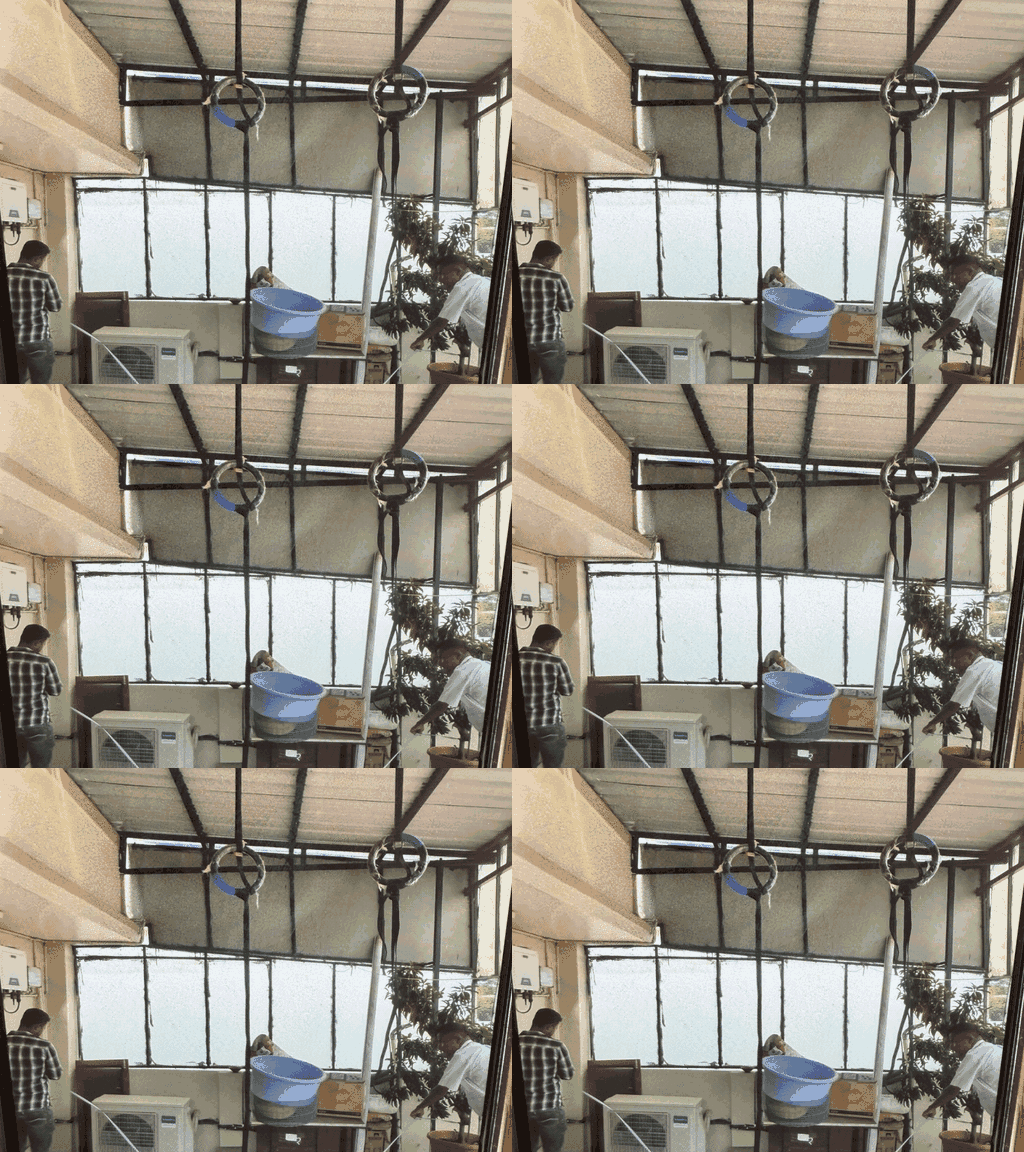
The part of the house where Twisha’s dead body was found.
Samarth Singh claims behaviour changed after pregnancy
Twisha’s husband Samarth Singh is currently under seven-day police remand.
During questioning, he reportedly told investigators that their relationship was normal after marriage but Twisha’s behaviour changed after her pregnancy was confirmed.
According to Samarth, Twisha often expressed that balancing domestic life with the glamour industry had become difficult for her, which increased tension between the couple.
He also stated that on the evening of May 12, Twisha returned from a beauty parlour, after which the two went for a walk, had dinner together and spent time together. Later, she allegedly spoke with her family members over the phone.
AIIMS Delhi team to return to Bhopal today
A team from AIIMS Delhi conducted a second postmortem examination on Twisha’s body on Sunday.
The procedure lasted around three hours at AIIMS Bhopal, following which the team left with photographs, videos and written observations. The team is expected to return today with its findings.
Professor and Head of the Department of Forensic Medicine and Toxicology at AIIMS Delhi, Dr. Sudhir Kumar Gupta, said the final postmortem report would take time.
He stated that histopathology and viscera analysis are still pending.
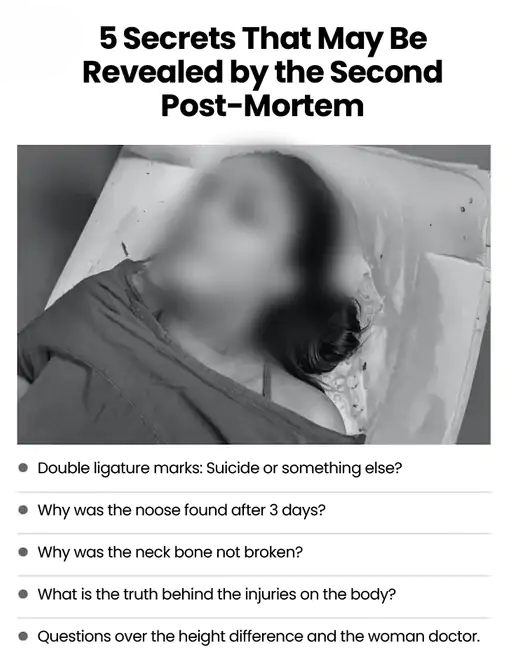
Key questions surrounding the investigation
1. Questions over double ligature marks
The first postmortem report reportedly recorded two parallel ligature marks on Twisha’s neck.
According to the report, the noose appeared to have wrapped around the neck twice. Despite this, the cause of death was listed as “suicide by hanging.”
Twisha’s family argues that such marks are uncommon in ordinary hanging cases.
2. Delay in recovery of the noose
At the time of the first postmortem examination, the alleged noose was neither handed over to doctors nor seized by the police.
After objections were raised by family members, the noose was reportedly recovered on May 15.
Experts say that in such cases, the noose is generally sent along with the body for forensic examination. The delay has raised questions regarding police procedure.
3. Injury marks found on the body
According to Twisha’s family, several injury marks were found on her body.
Multiple wounds were reportedly found between her left elbow and wrist. The first postmortem report stated that the injuries may have been caused by the impact of a hard object.
However, the report reportedly contained limited details regarding the depth and severity of the injuries.
4. Questions over intact hyoid bone
Medical experts say that in many hanging cases, the hyoid bone or thyroid cartilage is often affected.
However, the first postmortem report reportedly described these structures as intact. Although blood traces in tissues were mentioned, the report did not provide detailed comments on the preserved condition of the bone.
This aspect is also expected to be reviewed during the second postmortem examination.
5. Discrepancy in height raises questions over medical examination
Questions have also been raised regarding Twisha’s height mentioned in the first postmortem report.
The AIIMS Bhopal report reportedly recorded her height as 166 centimetres, while family members claim she was 172 centimetres tall.
Advocate Ankur Pandey has questioned the accuracy of the report and the functioning of the medical panel involved in the first examination.