

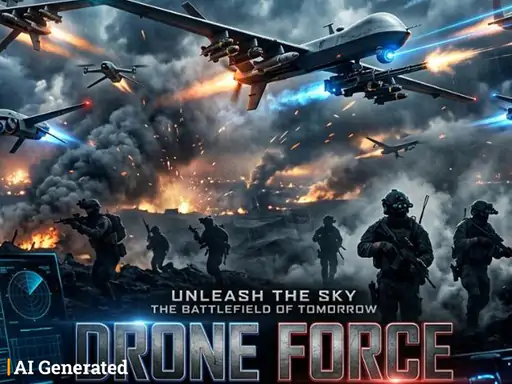
Taking lessons from Operation Sindoor and global wars (Russia-Ukraine and West Asia), the Indian defence establishment has decided to create a ‘Drone Force’. This force will be deployed as the ‘first responder’ in any military operation. It will be supported technologically by a data and cognitive warfare force.
According to the Integrated Defence Headquarters, around 50,000 military personnel are currently being trained for this force. Over the next three years, 15 new ‘Centres of Excellence’ will be established. Here, real-time battle training will be provided using simulators and virtual reality.
In the future, security forces such as the BSF and ITBP will also be integrated into this network. This force will play a dual role in intelligence, surveillance, and precision strikes. This system will be backed by the Air Force’s Integrated Air Command and the Army’s ‘Akashteer’ system.
Defense ecosystem also new, with integrated armed forces
Since Operation Sindoor, India has significantly strengthened its defence production ecosystem, which has now reached ₹1.54 lakh crore. The process of creating theatre commands for the three services is underway. To counter cheap enemy drones, the armed forces are now using both cost-effective ‘soft kill’ methods (jamming/spoofing) and ‘hard kill’ systems (laser-based directed energy weapons).
It is worth noting that the idea of a dedicated drone force emerged last year after Pakistan launched an attack involving around 1,000 drones. The objective was to identify gaps in India’s air defence systems and inflict economic damage by forcing the use of expensive missile-based defences against low-cost drones.
Every soldier to have a personal drone
The Army plans to provide basic drone training to every soldier in this proposed drone force. The goal is that every soldier on the battlefield will have access to a personal drone. Additionally, each Army corps is planned to be equipped with 8,000 drones, building a massive force of around one lakh drones.
Indigenous capabilities and defence ecosystem growth
This year alone, 120 defence startups have been established, with around 20 new companies focused specifically on drones, AI, and electronic warfare. These are supported by 16,000 MSMEs. Around 75% of India’s ₹7.85 lakh crore defence budget is now being spent domestically. Defence imports have also declined by 11–15% in the past year.
Critical components such as missile “seeker” systems (sensors) and engines are now being developed within India by companies like PTC Industries, Data Patterns, and Solar Industries. Earlier, these components were imported from Russia. Indigenous content in the BrahMos missile has increased from 15% in 2015 to 72% today.
Missile maintenance to be done in India
In another major development, the Indian Air Force has signed an agreement with European defence giant MBDA. Under this deal, maintenance of MICA air-to-air missiles used in Rafale fighter jets will now be carried out in India. Facilities for Maintenance, Repair, and Mid-Life Overhaul (MRO) will be set up domestically.
This move comes just before India’s proposed acquisition of 114 additional multirole fighter aircraft. The MICA missile, with a range of 60–80 km, is used in Rafale jets for both beyond-visual-range and close-combat (dogfight) missions.
Future warfare will be multi-domain and AI-driven
According to retired Air Commodore Gaurav M Tripathi, future operations will be multi-domain—spanning from space to sea. Communication systems will evolve from linear chains to integrated networks or “webs.”
He also warned that future threats may include hardened drones that are difficult to jam, with improved navigation systems, GPS-independent operation, electro-optical homing, and swarm attack capability.
To counter these, India will need to expand its anti-drone capabilities across all critical installations and strengthen communication systems against electronic and cyber warfare threats.