
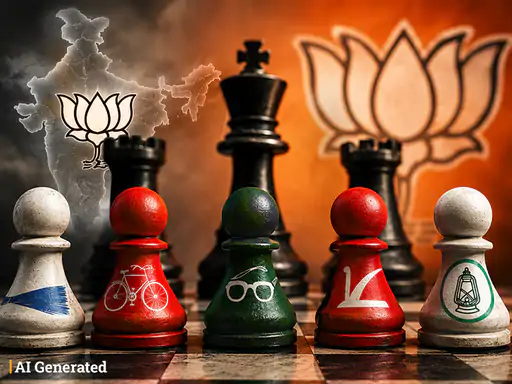
The defeat of Mamata Banerjee’s All India Trinamool Congress marks a significant shift in Indian politics, as the BJP’s expanding dominance reshapes the space for regional forces. From Yadav’s in UP and Bihar, to Thackeray’s in Maharashtra, Muftis in Kashmir, Badals in Punjab, and Congress’s Gandhis, regional parties are increasingly operating in a political landscape defined by the Centre, making survival more complex than ever.
But even as regional parties weaken, others are emerging anew. In Tamil Nadu, voters have backed a fresh young face, raising a larger question: what does it now take for regional parties to survive in the age of the BJP?
Let’s decode…
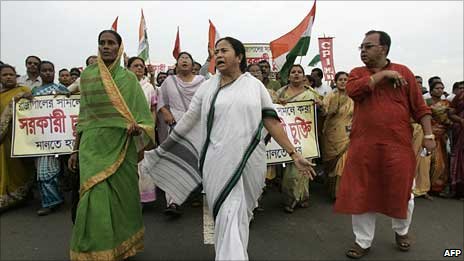
On May 20, 2011, after taking oath as Chief Minister, Mamata walked from Raj Bhavan to Writers’ Building with thousands of supporters behind her.
How Mamata Banerjee built TMC a Bengal’s regional force?
All India Trinamool Congress (TMC) was formed on January 1, 1998 by Mamata Banerjee, during a period when several strong regional parties were emerging across India.
- After 1991, Mamata’s relationship with Congress began to worsen. She wanted to remove the Communists from Bengal, but believed some Congress leaders in Delhi were secretly helping the Left. She famously called such leaders “Tarbooja” (watermelon), green outside like Congress, but red inside like the Communists.
- Tensions kept growing. In 1992, in front of Prime Minister P. V. Narasimha Rao, Mamata announced her resignation from the government.
- The final break came in 1997 when she lost the Bengal Congress president election by just 27 votes. Mamata believed her own party colleagues had worked against her.
- Soon after forming TMC, Mamata made a major impact in the 1998 Lok Sabha elections. TMC won 24 seats in West Bengal, while Congress was reduced to just one seat.
- Around the same time, Atal Bihari Vajpayee was rising nationally. Mamata joined the NDA, saying, “the enemy of an enemy is a friend.” In 1999, she became Railway Minister in the Vajpayee government.
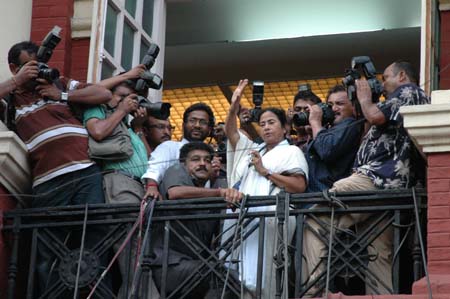
- Between 2000 and 2003, she resigned from the NDA government three times over issues like rising petrol prices, the Tehelka scandal, and railway division disputes — but each time returned on her own terms, strengthening her image as an independent leader.
- In 2009, Mamata staged a huge comeback, winning 19 Lok Sabha seats and becoming Railway Minister again. Her real target, however, was Bengal in 2011.
- That moment arrived in the 2011 West Bengal Assembly elections, when TMC defeated the 34-year-old Left Front government. TMC won 180 out of 294 seats, ending decades of Communist rule in Bengal.
However, after nearly 15 years in power, Mamata Banerjee’s rule came to an end on May 4, 2026, when the BJP stormed to victory in the West Bengal Assembly elections and formed the government in Bengal for the first time since India’s independence.
Which regional parties have survived in India?
Regional parties fold into national power blocs
- In Bihar, Janata Dal (United) rejoined the BJP-led NDA under Nitish Kumar, helping the alliance win 30 of Bihar’s 40 Lok Sabha seats in 2024, with the BJP and JD(U) winning 12 seats each.
- At the state level, BJP leader Samrat Choudhary currently serves as Bihar’s Chief Minister.
- In Andhra Pradesh, Telugu Desam Party (TDP) chief N. Chandrababu Naidu staged a powerful comeback in alliance with the BJP and Jana Sena Party in 2024.
- The TDP won 16 of the state’s 25 Lok Sabha seats, emerged as a key NDA power broker in Delhi, and swept back to power in the state with Naidu returning as Chief Minister.
SP–Congress pushed for a wider anti-BJP alliance in Uttar Pradesh
- In the 2024 Lok Sabha election, the Samajwadi Party-Congress alliance significantly dented the BJP in Uttar Pradesh, India’s largest Lok Sabha battleground with 80 seats: the SP won 37 seats, Congress 6, while the BJP was reduced to 33, including its high-profile defeat in Ayodhya’s Faizabad constituency after the Ram Mandir inauguration. The seat was won by SP.
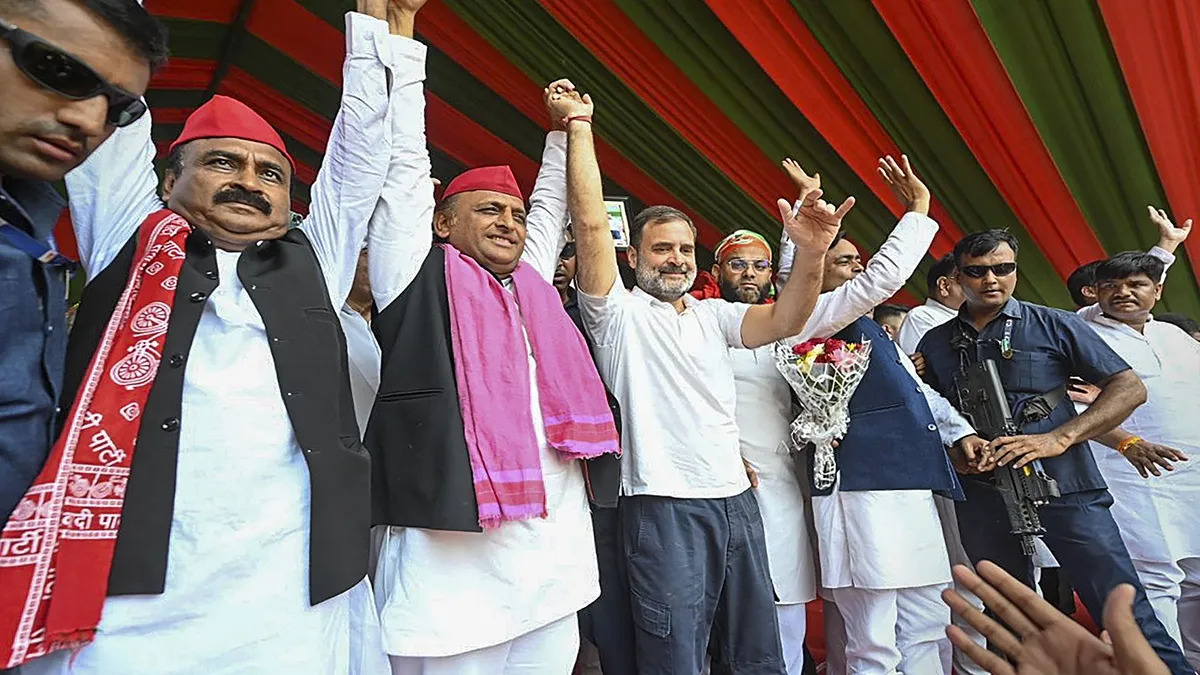
In the 2024 Lok Sabha elections, the Samajwadi Party–Congress alliance made significant gains in Uttar Pradesh, cutting into the BJP’s dominance in the state. (Photo: PTI)
- Even before the 2024 Lok Sabha election, Samajwadi Party had significantly dented the BJP in the 2022 Uttar Pradesh Assembly polls, increasing its tally from 47 seats in 2017 to 111 seats in 2022 under Akhilesh Yadav.
- Although the BJP retained power with 255 seats, the SP re-emerged as the state’s principal opposition force.
Which regional parties are on the verge of decline?
Shiv Sena, Maharashtra
Founded in 1966, Shiv Sena received backing from Congress leaders like Vasantrao Naik and Yashwantrao Chavan, who were concerned about the growing influence of Left-backed and socialist trade unions in Mumbai’s industries.
- The party was created as a counterforce to militant labour politics that many believed was hurting Mumbai’s industrial economy.
- Over time, Shiv Sena sidelined Mumbai’s Left-backed trade unions and transformed into a major political force, even producing chief ministers like Manohar Joshi (1995–1999), Uddhav Thackeray (2019–2022), and Eknath Shinde (2022–present/now split).
- But today, the party has weakened due to internal splits and the BJP’s rise in Maharashtra.
Significantly Shiv Sena’s shift from Maharashtrawad to Hindutva allowed Narendra Modi and the BJP to enter and dominate what was once Shiv Sena’s exclusive space.
Aam Aadmi Party, Arvind Kejriwal, Delhi
Born out of the India Against Corruption movement, Aam Aadmi Party was founded in 2012 by Arvind Kejriwal on the clean-image appeal of Anna Hazare or a “saaf suthra” image associated with activist Hazare, rather than a fixed ideology.
- The ideology of Kejriwal and AAP has often been debated because it does not fit neatly into traditional political categories. Over time, the party focused more on governance delivery, free electricity, water, education and healthcare schemes, than a clearly defined ideological framework, a model later replicated by several parties.
- Talking to Bhaskar English, political expert Imankalyan Lahiri says this reflects a broader shift in Indian politics. AAP leaders frequently invoke Bhagat Singh and B. R. Ambedkar, though Lahiri argues these references are often more symbolic than ideological.
Kejriwal has also invoked “Ram Rajya” in speeches while largely avoiding direct ideological confrontation with the BJP on Hindutva politics. On contentious issues like the CAA-NRC protests too, AAP often adopted a cautious stance, something Lahiri describes as “a politics of careful balance rather than firm conviction.”
Aam Aadmi Party rapidly rose in Delhi, with Arvind Kejriwal serving a brief 49-day term in 2013 before sweeping the 2015 and 2020 Assembly polls with 67 and 62 seats respectively. The party later stormed to power in Punjab in 2022 with 92 of 117 seats.
But AAP’s dominance has since weakened: it lost Delhi’s municipal control and suffered a major blow in the 2025 Delhi Assembly election, where the BJP won 48 of 70 seats while AAP was reduced to 22.
The party now faces anti-incumbency pressure in Punjab amid competition from both Congress and the BJP ahead of 2027 Punjab assembly elections.
Odisha, Biju Janata Dal
Founded in 1997 by Naveen Patnaik in memory of his father Biju Patnaik after the breakup of the Janata Dal, Biju Janata Dal first rose with BJP support before breaking away in 2009 and dominating Odisha politics for nearly two decades.
But in 2024, the BJP ended Naveen Patnaik’s 24-year rule by winning 78 of Odisha’s 147 Assembly seats, while the BJD fell to 51. In the Lok Sabha polls too, the BJP won 20 of Odisha’s 21 seats, pushing the BJD into its deepest crisis yet
DMK and AIADMK, Tamil Nadu
Dravida Munnetra Kazhagam, founded in 1949 by C. N. Annadurai after splitting from Periyar’s Dravidar Kazhagam, the DMK built its rise on:
- Anti-Hindi mobilisation.
- Social justice.
- Tamil identity.
It entered electoral politics in 1967 and ended Congress dominance in Tamil Nadu, marking the rise of Dravidian politics in the state.
DMK, in 1967, wholeheartedly contested elections and won power.
It has not lost power in the state since then until now.
Is Vijay Thalpathy the ‘same old vine in a new bottle’?
In their 50th year 2026, the Dravidian forces (DMK and AIADMK) lost electoral power in their home state against the actor turned politician Vijay Thalpathy’s stunning debut in the 2026 Tamil Nadu assembly elections.
- Vijay who is eying the CM post, is a fresh face in Tamil Nadu’s politics calling the BJP his ideological enemy and the DMK his political rival, yet many of his positions closely mirror the state’s Dravidian politics followed by both the DMK and AIADMK.
Like the DMK and AIADMK, Vijay:
1 Opposes the NEET medical exam. 2 Supports moving education back to the State List. 3 Backs the two-language policy of Tamil and English, reflecting Dravidian politics long-standing anti-Hindi stance.
The numbers show that Dravidian politics remains firmly dominant in Tamil Nadu, not weakened.
- Vijay’s Tamilaga Vettri Kazhagam (TVK) won 108 seats, while the two traditional Dravidian giants, DMK and AIADMK won 59 and 47 seats respectively.
- Together, Dravidian parties secured 214 of Tamil Nadu’s 234 seats and nearly 81% of the total vote share.
- What has changed is not the ideology, but a party now competing to represent Dravidian ideology.
Vijay’s post-election symbolism made that clear:
He paid tribute to Periyar E. V. Ramasamy, founder Draviadian politics, of C. N. Annadurai, founder of DMK, B. R. Ambedkar, M. G. Ramachandran and K. Kamaraj, signalling a blend of Dravidian identity, welfare politics and constitutional social justice rather than a new ideological path.
Why only few regional political parties survive?
Political expert Imankalyan Lahiri explains this.
Some political trends help explain why only a few regional parties manage to survive and stay relevant over long periods.
- Parties with a clear ideology tend to last longer because they are not dependent only on personalities or short-term electoral gains.
- Parties with a committed vote base, often rooted in caste or religion, or a combination of both, such as the Samajwadi Party and the Rashtriya Janata Dal, tend to be more durable because they can rely on a stable core support.
- Parties that are deeply embedded in state politics, where competition is mainly between regional forces, tend to be more stable.
States like Andhra Pradesh and Tamil Nadu are examples where regional parties remain strong over time, even if their strength rises and falls.
- In contrast, regional parties that directly compete with a dominant national party based in Delhi, earlier the Congress and now the BJP, often face greater pressure.
- With a stronger Centre and more centralised political dynamics, these parties find it harder to win consistently and sustain their position.
This is further shaped by Centre–state relations, which are often uneven. In such a system, a strong central government can influence state-level political competition in ways that make it more difficult for regional challengers to survive and grow.