


Today is the 19th day of activist Sonam Wangchuk’s hunger strike.
As the 59-year-old Wangchuk entered the 18th day of his fast on 15 July, a petition in the Delhi High Court triggered a debate that goes beyond politics: can a person who chooses not to eat be fed against their will?
The plea seeks urgent medical intervention for Wangchuk, arguing that his health is deteriorating and asking authorities to hospitalise and force-feed him if necessary.
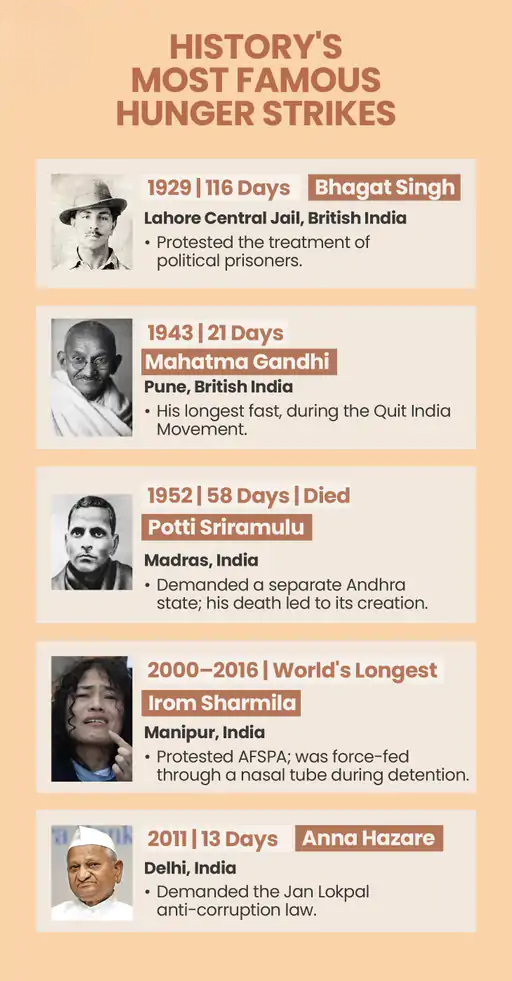
The case has put the spotlight on a controversial practice used in prisons and medical emergencies across the world. It has also revived another question: how long can the human body survive without food?
Let’s break it down.
Who filed the PIL and what does it say?
The PIL was filed by advocate and activist Rakesh Kumar Saini.
- He has asked the Delhi High Court to shift Sonam Wangchuk to a hospital and provide medical treatment, including force-feeding if required.
- The petition says Wangchuk has lost around 8.5 kg, his health is worsening, and his life could be at risk if the hunger strike continues.
- Saini argues that the government cannot remain a silent spectator when a citizen’s life is in danger.
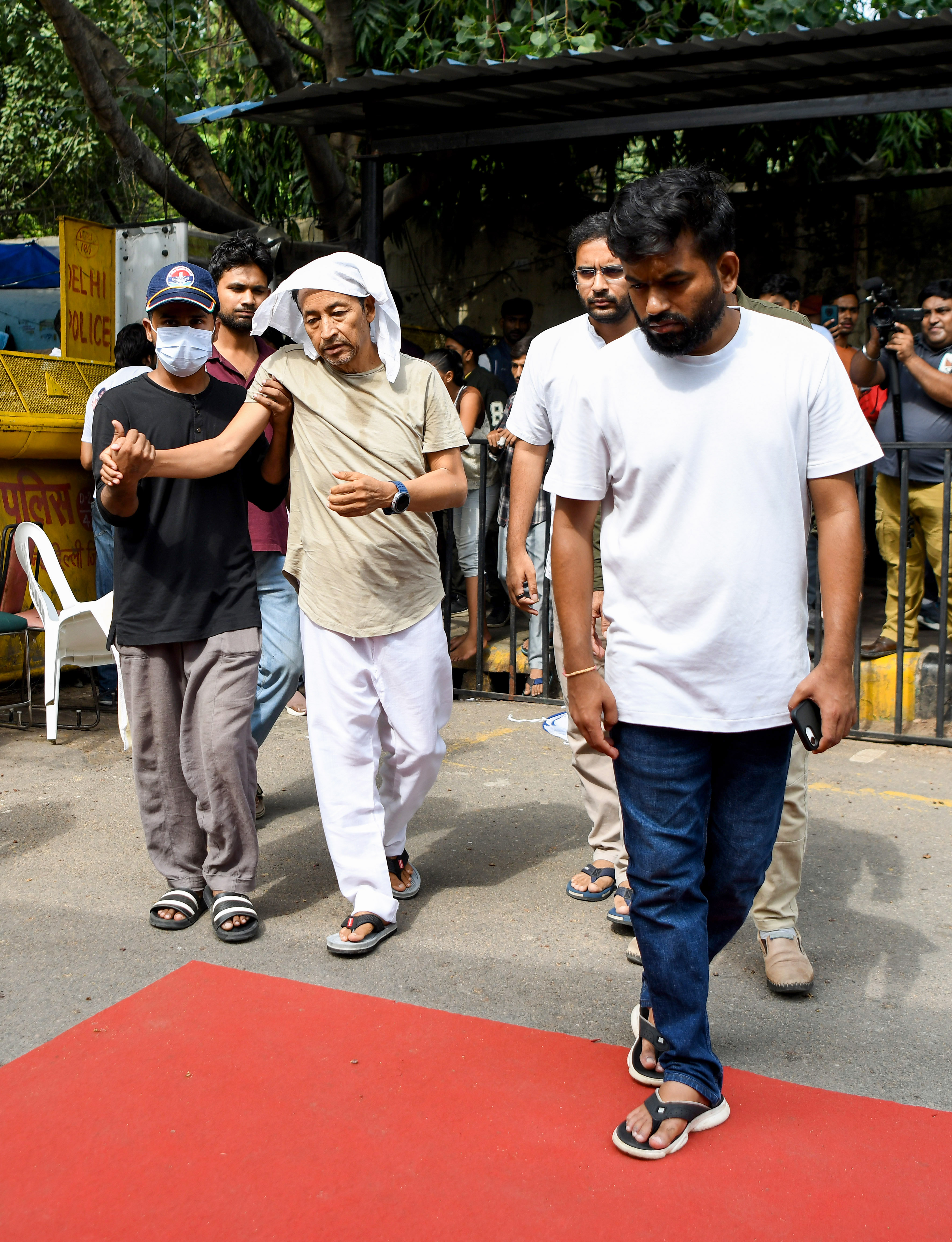
Environmentalist Sonam Wangchuk walks with support on the 18th day of his indefinite hunger strike during a protest at Jantar Mantar in New Delhi on 15 July, with CJP founder Abhijeet Dipke also present.
CJP founder Abhijeet Dipke said:

Wangchuk has started losing muscle mass and is in “immense pain”. He added that the activist has lost 8.5 kg since the beginning of his hunger strike.
What is force-feeding, and can the state legally do it to a hunger striker?
Force-feeding means giving food or nutrients to someone who refuses or is unable to eat voluntarily.
This is usually done through a tube inserted through the nose into the stomach. The aim is to prevent starvation and save lives.
Whether the state can do this to a hunger striker is not straightforward. Indian courts generally balance two rights: a person’s right to make decisions about their own body and the state’s duty to protect life.
There is no law that automatically allows force-feeding. Courts usually decide on a case-by-case basis, depending on the person’s health condition and the risk to life.
Why is Sonam Wangchuk on a hunger strike?
Sonam Wangchuk joined a protest at Delhi’s Jantar Mantar that is demanding the resignation of Union Education Minister Dharmendra Pradhan over alleged irregularities in examinations, including NEET.
- The protest began earlier in June. Wangchuk started his own indefinite hunger strike on 28 June and has continued it since then.
- His supporters say the fast is aimed at drawing attention to the issue and seeking accountability.
Can a person survive without both food and water?
Not for long. Experts say a person may survive for several weeks, and in some cases even a few months, without food if water is available.
- But if both food and water are withheld, survival time drops sharply.
- Most people cannot survive much beyond about a week without water, though this can vary depending on age, health and environmental conditions.
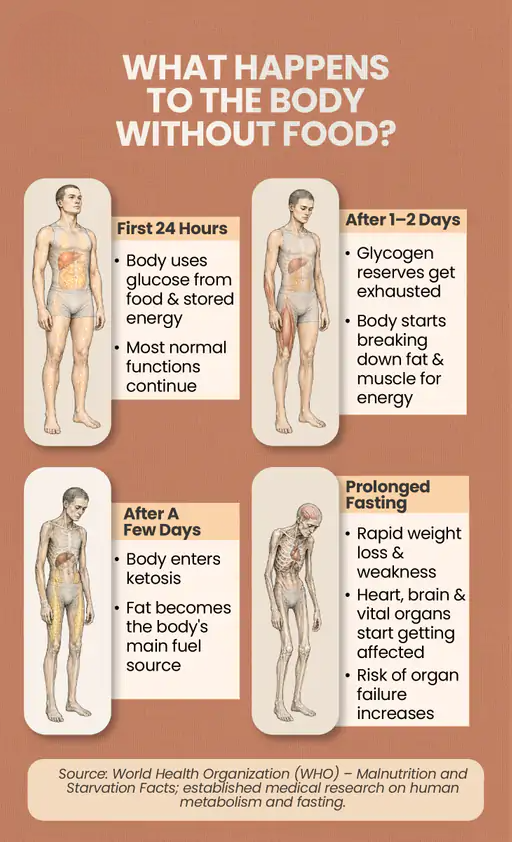
How long can a person survive without food?
The body does not stop functioning immediately after food intake stops.
- For the first 1–2 days, it uses glucose and stored glycogen for energy. Once these reserves are depleted, the body starts burning stored fat.
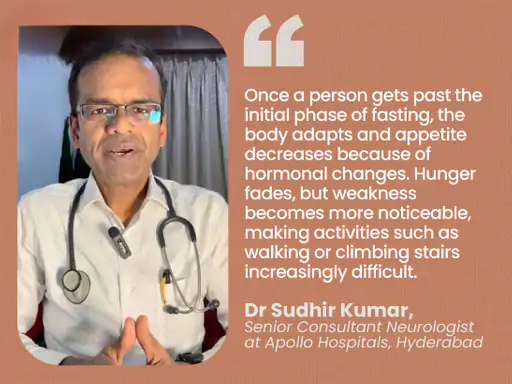
According to neurologist Dr Sudhir Kumar:
After around three days of fasting, the brain begins using ketones produced from fat as fuel. This helps the body conserve muscle and continue functioning. For nearly two weeks, stored fat remains the body’s main energy source.
- After two weeks, the body starts breaking down muscle for energy. Energy reserves decline, and the risk of organ damage involving the heart, kidneys and liver increases.
- Studies show some hunger strikers have survived 28 to 40 days, while during the 1981 Northern Ireland hunger strike, deaths occurred after 46 to 73 days.
- With enough water, a person can survive roughly 45 to 70 days without food, depending on health, body weight and hydration. Without water, survival usually drops to 3–7 days.
Why is water more important than food for survival?
Food provides energy, but water keeps the body’s essential systems working.
- Water helps regulate body temperature, transport nutrients, maintain blood circulation and remove waste from the body.
- When a person stops eating, the body can switch to stored fat and muscle for energy.
But without water, dehydration develops rapidly. Blood volume falls, organs receive less oxygen and nutrients, kidney function declines and the risk of organ failure rises sharply.
That is why people can survive much longer without food than without water.

Why does hunger fade during a prolonged fast?
Many people assume hunger keeps increasing during a hunger strike. In reality, it often fades after the first few days.
- According to Dr Sudhir Kumar, hunger is usually strongest during the first one or two days. As the body adapts to starvation, hormone levels change and appetite gradually decreases.
“Once a person gets past the initial phase, the body adapts. Because of hormonal changes, appetite decreases,” he says.
But while hunger fades, weakness grows.
“A person may not feel very hungry, but they are likely to feel increasingly weak. Activities such as walking, climbing stairs or any physical exertion become more difficult,” Dr Kumar says.
- He adds that the brain continues to function because it starts using ketones as an alternative source of energy. A person can remain conscious and make decisions normally, though concentration, attention span and reaction time may gradually decline.

59-year-old Sonam Wangchuk has been on an indefinite hunger strike for 17 days. He is surviving only on salt water and has lost 8.5 kg. Behind him hangs a Cockroach Janata Party (CJP) banner demanding Education Minister Dharmendra Pradhan’s resignation. CJP founder Abhijit Dipke said, “The government is not even willing to talk. They have left him to die.”