

As US Secretary of State Marco Rubio visits India ( 23-26 May) for crucial Quad talks, his remarks on oil diplomacy, Venezuela and India’s energy choices have triggered a fresh political controversy.
From openly offering unlimited American oil to India to revealing the expected visit of Venezuela’s acting president Delcy Rodríguez before any official confirmation from New Delhi, Rubio’s statements have raised questions over diplomacy, transparency and foreign policy autonomy.
Congress leader Jairam Ramesh has now publicly questioned why an American official appears to be announcing sensitive India-related diplomatic developments first.
In today’s Explained, we take a look at what Marco Rubio said before landing in Delhi, why it has sparked political reactions, and whether the controversy points to a larger debate over India’s strategic independence.
What has Marco Rubio said before arriving in Delhi?
Ahead of his India visit, US Secretary of State Marco Rubio said on 20 May that Washington and New Delhi are discussing ways to deepen energy ties, adding that the subject would feature prominently during his India visit.
Addressing reporters in Miami, Rubio stated, “We are prepared to supply as much oil as India wants to buy from us. The United States is currently producing and exporting oil at record levels.”
Speaking about energy trade, Rubio said the United States wants American oil and gas to play a bigger role in India’s energy mix.
He also pointed to possible cooperation involving Venezuelan crude, noting that Venezuela’s acting president Delcy Rodríguez is likely to visit India next week. Rubio added that India and Venezuela have significant scope to expand cooperation in the energy sector.
Why has Jairam Ramesh raised questions over Rubio’s remarks?
Senior Congress leader Jairam Ramesh questioned Rubio’s remarks and raised concerns over the disclosure. In a post on X, Ramesh said, ‘US Secretary of State Marco Rubio has once again been the first to announce that Venezuela’s president is coming to India next week.’
- Interestingly, neither India nor Venezuela had indicated or officially confirmed this visit.
- The question now is, the Congress leader wrote on X ‘what other information regarding India’s foreign policy does the US Secretary of State already possess, and what else might he make public in the future?’
Why is Marco Rubio visiting India?
US Secretary of State Marco Rubio is visiting India from 23 to 26 May for the Quad foreign ministers’ meeting involving India, the United States, Japan and Australia. During the visit, he will travel to Kolkata, Agra, Jaipur and New Delhi.
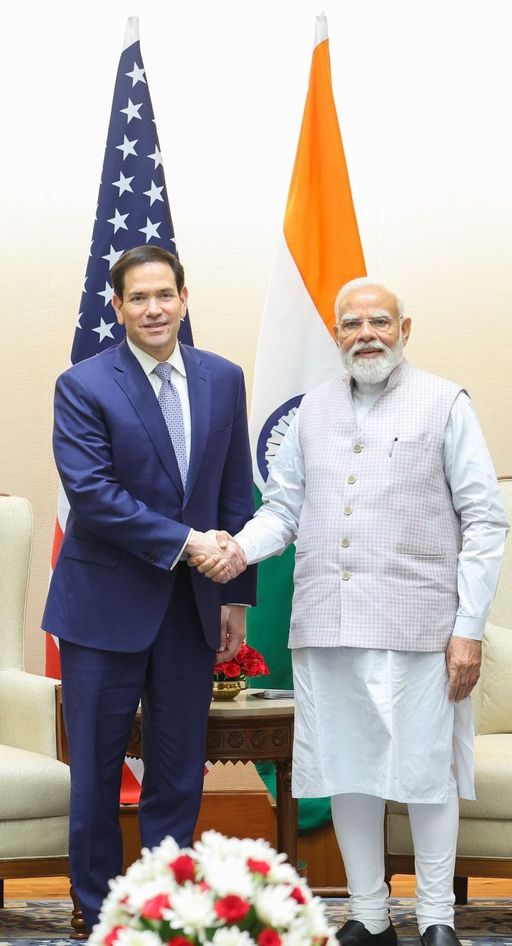
US Secretary of State Marco Rubio met Prime Minister Narendra Modi on 23 May.
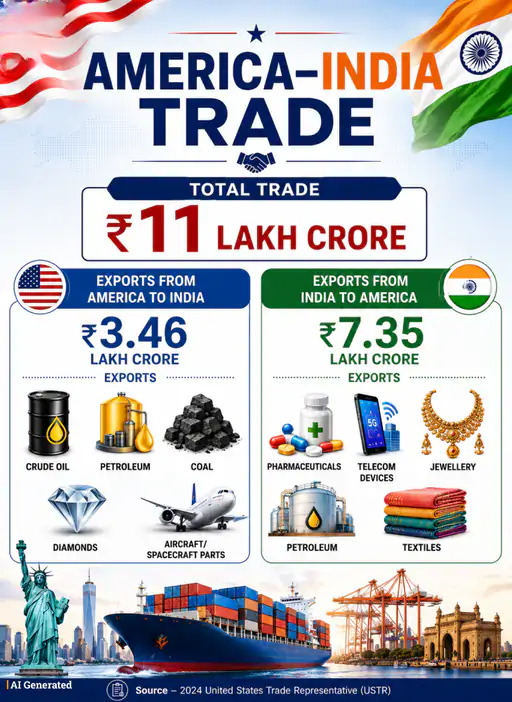
Energy security is expected to be a key focus. India is buying discounted Russian crude oil, while the US wants India to increase imports of American oil and LNG gas. With Middle East tensions affecting global energy supplies, India is trying to diversify energy sources to reduce risks during future crises.
Talks are also expected on trade, tariffs, investment, critical minerals supply chains, semiconductors, battery manufacturing, artificial intelligence and advanced technologies, as both countries look to strengthen ties after recent trade differences.
Defence cooperation will also feature prominently. India already operates several US-made defence platforms, including P-8 Poseidon aircraft, MQ-9B SkyGuardian drones, M-777 howitzers and C-17 Globemaster III transport aircraft. Both sides are also exploring joint defence production and military technology cooperation.
Rubio, known for his tough stance on China, has long supported closer India-US strategic ties. Experts say the visit highlights Washington’s view of India as a key strategic partner in Asia.
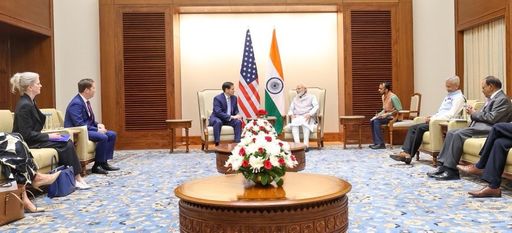

The meeting between US Secretary of State Marco Rubio and PM Modi lasted for nearly an hour. External Affairs Minister S. Jaishankar, National Security Adviser Ajit Doval and US Ambassador Sergio Gor were present during the meeting.
What is India’s foreign policy?
India’s foreign policy is built around one core idea: strategic autonomy, maintaining ties with multiple global powers without becoming dependent on any one bloc.
After Independence, Prime Minister Jawaharlal Nehru shaped this approach through the Non-Aligned Movement, keeping India out of both the American and Soviet camps during the Cold War. Today, diplomats describe the same philosophy as “multi-alignment”.
- India now works with the US in the Quadrilateral Security Dialogue, buys defence equipment from Russia, maintains ties with Iran and the Gulf, and simultaneously competes and cooperates with China. External Affairs Minister S. Jaishankar has repeatedly described this as pursuing “India’s national interest first”.
The government echoed this in a December 2024 Lok Sabha reply.
- Minister of State for External Affairs Kirti Vardhan Singh said India’s foreign policy is evolving around securing national interests, protecting Indians abroad, and reflecting India’s “growing stature” on the world stage.
- The reply said India’s diplomacy is guided by the ‘Neighbourhood First’, ‘Act East’, ‘Think West’ and ‘Connect Central Asia’ policies, along with the SAGAR maritime initiative.
- India is also expanding its role through forums like BRICS, the Shanghai Cooperation Organisation and the Quad, while leading initiatives such as the International Solar Alliance and the India-Middle East-Europe Economic Corridor.
- The government called Association of Southeast Asian Nations a “key pillar” of India’s foreign policy and highlighted India’s 2023 G20 presidency as an opportunity to amplify the concerns of the Global South.
- Jaishankar in 2022, famously remarked:

Europe’s problems are the world’s problems, but the world’s problems are not Europe’s problems.
WATCH: EAM Jaishankar tells Marco Rubio on his face at a joint press conference on 24 May 2026 that India will firmly protect its national interests.
Like America first, we believe in India first.
Why has the US under Trump been acting aggressively?
India-US tensions have continued for a year
According to a New York Times report, Rubio’s visit is taking place at a time when tensions have been visible in India-US relations over several issues since the middle of last year.
- It is believed that one of the objectives of the visit is also to strengthen ties between the two countries once again.
- It is now being seen that the main purpose of Rubio’s discussions in Delhi is to help India understand what strategy the Trump administration intends to adopt in Asia going forward and what direction its relationship with China may take.
- Last year, Trump imposed heavy tariffs on India after Prime Minister Modi reportedly refused to nominate him for the Nobel Peace Prize.
- Trump had claimed that he played a major role in stopping conflict between India and Pakistan, but India publicly rejected the claim.
A fresh source of tension has now emerged over Pakistan.
- Trump has recently praised Pakistan’s leaders and described them as mediators in the Iran war.
- This has created a perception in India that the Trump administration is once again giving importance to Pakistan.
Trump
Donald Trump’s foreign policy has largely operated through transactional pressure rather than traditional diplomacy. His approach towards allies and rivals alike has often involved tariffs, public threats, sanctions and economic leverage.
During both his political phases, Trump repeatedly criticised India’s tariffs, trade barriers and energy partnerships with Russia. In recent years, Washington has openly pressured India over Russian oil imports, arguing that such purchases indirectly help Moscow during the Ukraine war.
At the same time, Trump also sees India as strategically important against China. This has created an unusual contradiction in American policy: Washington wants India as a geopolitical partner, but also wants New Delhi to align more closely with US economic and strategic expectations.
That contradiction explains why American officials often sound simultaneously cooperative and confrontational. Marco Rubio’s recent remarks offering “as much oil as India wants” fit into this broader strategy of trying to pull India away from Russian energy dependence while deepening US influence in India’s energy market.
Some foreign policy experts believe Trump’s style also reflects a broader American shift. The US increasingly expects strategic partners to publicly align with Washington on major global conflicts, especially involving China, Russia and energy security.
India, however, continues to resist formal alignment.
This tension has occasionally produced diplomatic friction, especially when US leaders publicly comment on India’s internal decisions, Pakistan relations, or foreign policy choices.
Why does Rubio want to strengthen Quad again?
US Secretary of State Marco Rubio said that the first major meeting he attended after becoming Secretary of State was with Quad countries. He said the United States now wants to strengthen the Quad once again. According to him, holding the next Quad meeting in India is not merely a formal decision. It is intended to show how important India is in America’s view.
Rubio said India has a very significant role in America’s Indo-Pacific strategy. The Quad includes India, the United States, Japan and Australia.
The grouping works together on issues such as maritime security, trade, emerging technologies and China’s growing influence.
He also said that the United States wants to further strengthen its relationship with India. “In the coming period, many new and major announcements regarding relations between the two countries will be seen,” he said.
How have India-US relations evolved through different foreign ministers?
According to the New Delhi-based think tank Observer Research Foundation, India-US relations have evolved from Cold War-era mistrust to a deep strategic and economic partnership shaped by trade, defence cooperation, and shared concerns over China.
ORF says ties were strained under Prime Ministers Jawaharlal Nehru and Indira Gandhi, as India pursued non-alignment and socialist policies while the US backed Pakistan during the Cold War and the 1971 war.
The think tank notes that economic reforms under P. V. Narasimha Rao in 1991 opened the door for stronger engagement, while Prime Minister Atal Bihari Vajpayee expanded ties despite tensions after the 1998 Pokhran-II nuclear tests.
According to ORF, ties “matured and deepened” under Prime Minister Manmohan Singh through the landmark civil nuclear deal with US President George W. Bush.
The think tank argues Prime Minister Narendra Modi further strengthened ties through defence, technology, Indo-Pacific cooperation and the Quadrilateral Security Dialogue (Quad), as the US seeks to “de-risk” from China under Xi Jinping.
ORF concludes that India-US ties are now built on a “future-proof strategic design” driven by defence partnerships, supply chains, high technology, and shared geopolitical interests.
What role has Pakistan played in India-US relations?
Pakistan has long been one of the biggest complications in India-US relations. During the Cold War and the Afghan wars, the US viewed Pakistan as a key military ally, while India accused Washington of overlooking Pakistan’s role in regional instability for strategic reasons.
Indian policymakers also criticised the “hyphenation” approach, where India and Pakistan were treated as part of the same regional equation. New Delhi argued India should be seen as a global power in its own right.
Tensions deepened after attacks linked to Pakistan-based groups, including the 2001 Parliament attack and the 2008 Mumbai attacks, with India pressing the US to act harder against militant networks.
In recent years, the US focus on China has strengthened India-US ties. But any renewed American military or diplomatic outreach to Pakistan still triggers concern in New Delhi, which opposes any revival of external mediation in India-Pakistan tensions.