
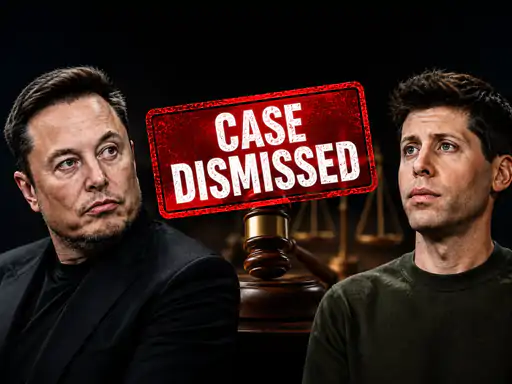
After years of public attacks, courtroom drama, and explosive allegations, Elon Musk has lost his legal battle against OpenAI.
A US jury ruled that Musk waited too long to file his case, dealing a major blow to the billionaire and removing one of the biggest legal hurdles facing the company behind ChatGPT.
What was the case about?

Musk accused OpenAI and its top executives, including CEO Sam Altman and President Greg Brockman, of abandoning the organization’s original mission. According to Musk, OpenAI was founded as a nonprofit to build artificial intelligence for the benefit of humanity. He claimed the company later shifted toward making profits and enriching its leaders.
Musk had asked the court to:
- Award him $150 billion in damages
- Remove Sam Altman from OpenAI’s board
- Undo OpenAI’s for-profit structure
The jury rejected all of these demands.
Why the jury ruled against Musk
The case was decided on timing rather than on whether Musk’s accusations were true. Under California law, such claims must be filed within three years of when the plaintiff became aware of the alleged wrongdoing.
Jurors concluded that Musk knew about OpenAI’s shift toward a for-profit model years earlier, but did not sue until August 2024.
The nine-member jury took less than two hours to reach a unanimous verdict.
Judge said Musk faces an uphill appeal
After the verdict, Judge Yvonne Gonzalez Rogers said there was strong evidence supporting the jury’s decision.

There’s a substantial amount of evidence to support the jury’s finding.
Musk has said he will appeal, but the judge indicated that overturning the decision could be difficult.
How the battle started
OpenAI was founded in 2015 by Sam Altman, Elon Musk, and several others as a nonprofit research organization.
Musk donated around $38 million to help launch the project and served on the board.
In 2018, Musk left OpenAI after reportedly failing to gain greater control over the organization.
In 2019, OpenAI created a for-profit arm to raise the massive funding needed to develop advanced AI systems. Microsoft later invested billions of dollars in the company.
OpenAI’s response

OpenAI argued that Musk knew about these plans long ago and chose to sue only after the company became a major competitor to his own AI venture, xAI.
Bill Savitt, OpenAI’s lawyer, said:
An after-the-fact contrivance that bears no relationship to reality.
He also described the case as:
A hypocritical attempt to sabotage a competitor.
Musk fires back
Following the ruling, Musk posted on X.
Altman & Brockman did in fact enrich themselves by stealing from a charity.
He added that allowing such actions would be harmful to charitable organizations in the United States.
What this means for OpenAI

The verdict is a major win for OpenAI. With the lawsuit out of the way, the company can move ahead more easily with a possible initial public offering (IPO) that could value it at around $1 trillion.
A Musk victory could have forced OpenAI to dismantle its current corporate structure, potentially disrupting one of the world’s most influential AI companies.
What this means for Musk
For Musk, the decision is a near-total defeat.
He receives:
- No damages
- No board changes
- No reversal of OpenAI’s business structure
Although he plans to appeal, the jury’s unanimous verdict and the judge’s comments suggest the road ahead will be difficult.
This case was about more than just a personal feud between two powerful tech leaders. It raised major questions about:
- Who should control artificial intelligence
- Whether nonprofits can transform into commercial giants
- Who should benefit from groundbreaking technology
The jury did not decide whether OpenAI betrayed its founding ideals. It only concluded that Musk filed his lawsuit too late. For now, OpenAI moves forward stronger than ever, while Musk’s challenge has been left behind in court.