

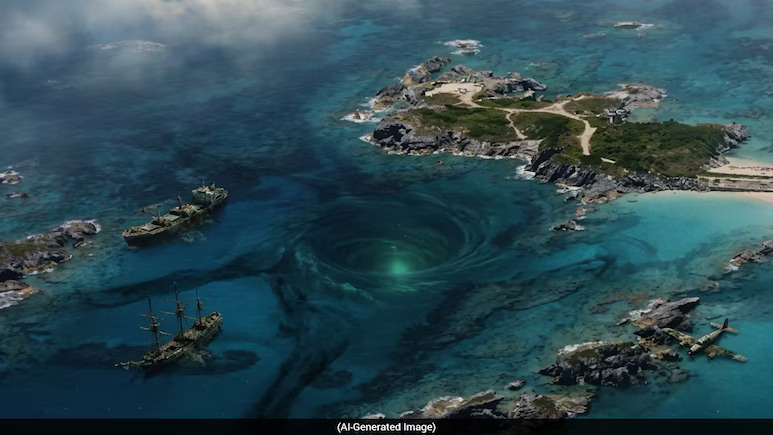
Bermuda still sits atop a broad swell, standing roughly 1,600 feet higher than the surrounding ocean floor, reports Carnegie Science.
For decades, geologists have been baffled by one of the Atlantic Ocean’s most persistent puzzles: why does Bermuda sit so high above the surrounding ocean floor, even though its volcanoes have been silent for more than 30 million years? Now, a team of American scientists believes it finally has the answer, and it lies hidden deep beneath the island itself.
New research led by William Frazer, a seismologist at Carnegie Science, and Jeffrey Park of Yale University reveals that Bermuda is supported by a type of geological structure unlike anything seen elsewhere on Earth, according to Carnegie Institution for Science.
Most volcanic island chains, such as Hawaii, form above what scientists call a mantle plume: a column of hot, buoyant rock that rises from deep within Earth’s mantle. As this material pushes upward, it creates volcanoes and causes the seafloor to bulge. Over time, as tectonic plates move away from the plume and volcanic activity fades, these swells typically sink back down. But not beneath Bermuda.
Bermuda still sits atop a broad swell, standing roughly 1,600 feet higher than the surrounding ocean floor, reports Carnegie Science.
To investigate, Frazer and Park used seismic waves generated by large earthquakes around the world. As these waves travel through the Earth, they speed up or slow down depending on the density and composition of the material they pass through, much like sound changing pitch as it moves through different substances. By analysing recordings from a seismic station on Bermuda, the researchers were able to create a picture of Earth’s interior down to about 20 miles beneath the island.
What they found was unexpected: a layer of rock more than 12 miles thick sitting just below the oceanic crust. This rock is less dense than the surrounding mantle, making it unusually buoyant. Instead of a plume pushing up from below, this lighter rock acts more like a raft, helping keep the seafloor and Bermuda afloat.
The researchers think this layer, known as an underplating, formed during Bermuda’s volcanic past tens of millions of years ago, when carbon-rich molten mantle rock intruded into the base of the crust and cooled in place. That material may have originated deep within Earth hundreds of millions of years earlier, during the formation of the supercontinent Pangea.
Frazer explained the significance of the find in plain terms. “Bermuda is an exciting place to study because a variety of its geologic features do not fit the model of a mantle plume, the classic way for deep material to be brought to the surface,” he said. “We observe thick underplating, something that is not observed at most mantle plumes. Combined with recent geochemical observations, this suggests that there are other convective processes within Earth’s mantle that have yet to be well understood.”
Frazer is now searching for similar features beneath other islands around the world, to determine whether Bermuda is truly one of a kind or simply the first discovered example of a broader phenomenon.